

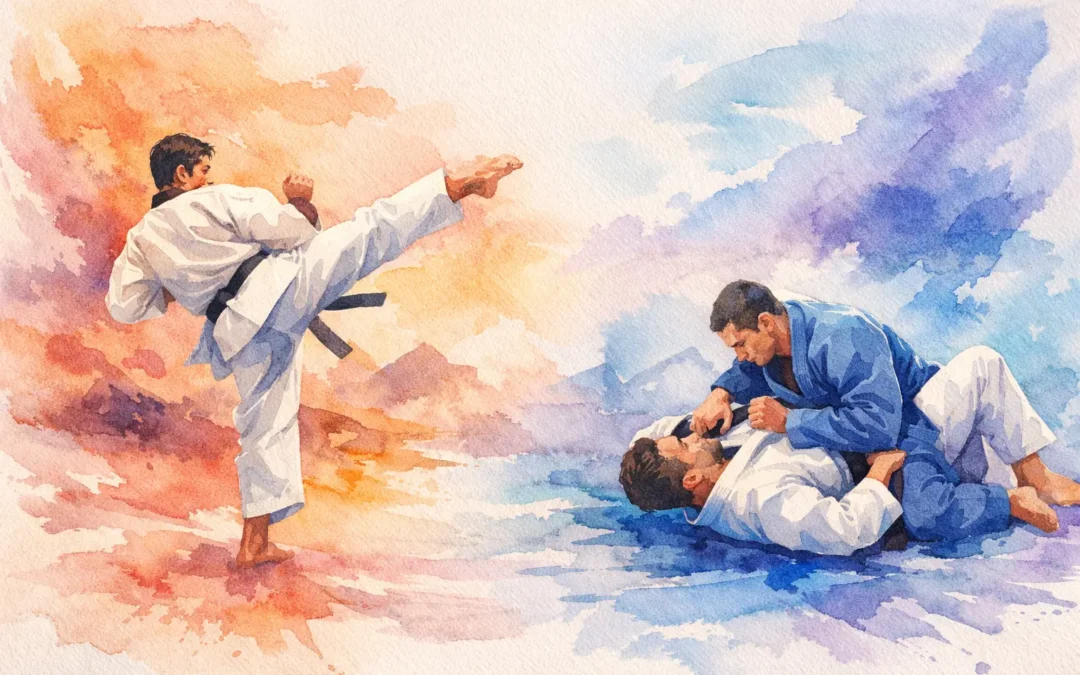
A martial arts class should feel like more than another workout you stop attending after a few weeks. For adults deciding between taekwondo or jiu jitsu, the better choice comes down to what you want to build: striking skill, close-range control, physical conditioning, confidence under pressure, or a new community that holds you accountable.
Both arts can change the way you move, think, and carry yourself. Both reward consistency, teach discipline, and give beginners a clear path forward. But the training experience is very different. Understanding those differences before your first class can help you choose a program you will be motivated to attend long enough to see real progress.
Taekwondo or Jiu Jitsu for Adults: The Core Difference
Taekwondo is primarily a striking art. Students learn how to use kicks, punches, footwork, blocks, timing, and distance to manage an encounter. Training often includes forms, pad work, controlled sparring, and drills that develop speed, coordination, flexibility, and precision.
Brazilian Jiu-Jitsu, often called BJJ, focuses on grappling. Students learn how to control an opponent through positioning, clinches, takedowns, escapes, pins, and submissions. Much of the work happens at close range or on the ground, where technique and leverage can allow a smaller person to manage a larger, stronger training partner.
Neither approach is automatically better. A strong decision starts with being honest about the kind of challenge that will keep you engaged. Some adults love the athletic rhythm and visible power of striking. Others prefer the problem-solving nature of grappling, where every round presents a new puzzle.
Choose Taekwondo if You Want Movement and Striking Skills
Taekwondo is an excellent fit for adults who want to become lighter on their feet, more coordinated, and more comfortable using distance. The kicking techniques are demanding in a productive way. They challenge balance, hip mobility, posture, and control while giving students a satisfying sense of progress as their technique sharpens.
For many beginners, taekwondo feels approachable because the structure is clear. You learn foundational stances, strikes, kicks, and defensive movements in a sequence. As your skill grows, you can see the difference in your form, power, speed, and confidence. Belt progression creates meaningful milestones without taking focus away from the daily work.
Taekwondo can also be a strong choice for adults who want an active, full-body training session without the sustained body-to-body contact of grappling. Sparring is still part of martial arts development, but it is controlled and built around safety, respect, and appropriate progression. A quality academy does not throw a new student into an overwhelming situation before they understand the basics.
This style can be especially rewarding if your daily routine has made you feel stiff, sedentary, or disconnected from your athletic side. The first few classes may reveal tight hips or limited range of motion, but that is not a reason to wait. It is a reason to begin with qualified instruction.
What Taekwondo Builds Beyond Fitness
The benefit is not just stronger legs or better cardio. Taekwondo develops composure. You learn to stay focused while moving, maintain your stance when you are tired, and execute a technique with intention instead of rushing. Those habits translate well to work, parenting, and any situation where a clear head matters.
Traditional taekwondo also places real value on courtesy, self-control, and respect. Adults often appreciate that the environment is disciplined without being cold. You are expected to work hard, support your classmates, and take ownership of your progress.
Choose Jiu Jitsu if You Want Close-Range Control
Jiu-Jitsu is often a natural fit for adults who want practical skill at close range. It teaches you what to do when space disappears: how to establish a safer position, protect yourself, escape pressure, and use leverage instead of relying only on strength.
The learning process is highly hands-on. You may practice a technique slowly with a partner, repeat specific movements, and then apply what you have learned during controlled live rounds. This gives adults immediate feedback. If a position works, you feel why it works. If it fails, you can adjust with coaching and try again.
Many people are drawn to jiu-jitsu because it is mentally engaging. A training round is not simply about pushing harder. It involves timing, body position, grip choices, patience, and problem-solving. You can train with people of different sizes and still find meaningful challenges because the goal is to apply technique intelligently.
There is a trade-off. Jiu-jitsu involves close contact and regular grappling. If that sounds uncomfortable at first, know that most beginners feel that way. A respectful academy will pair you thoughtfully, explain gym etiquette, and let you build confidence at a reasonable pace. Still, adults who strongly prefer personal space or want to focus exclusively on striking may enjoy taekwondo more.
Why Adults Stay With Jiu-Jitsu
Jiu-jitsu has a way of keeping training fresh. The same escape or guard position can create dozens of variations depending on your partner’s movement. Progress often comes in small breakthroughs: escaping a hold that once felt impossible, recognizing an opening earlier, or staying calm when a round becomes difficult.
That steady problem-solving develops resilience. You learn that being in an uncomfortable position does not mean you are defeated. It means you need to breathe, think, and apply what you have practiced.
Think About Your Self-Defense Goals Honestly
Both disciplines contribute useful self-defense skills, but they prepare you for different ranges. Taekwondo helps students understand distance, movement, striking mechanics, and how to create space. Jiu-jitsu helps students manage grabbing, clinching, restraint, and ground control.
Real self-defense is not a sporting event. Awareness, de-escalation, physical fitness, and the ability to leave safely matter more than proving who is tougher. The best martial arts training builds judgment alongside technique. It should teach you to avoid unnecessary conflict while preparing you to respond with control if there is no safe alternative.
Adults looking for a well-rounded path do not always have to choose one discipline forever. Starting with the art that matches your current goals is enough. Over time, cross-training can add valuable perspective. A taekwondo student can benefit from understanding grappling range, while a jiu-jitsu student can gain confidence from developing footwork and striking awareness.
Consider Your Fitness Preferences and Lifestyle
If you want dynamic movement, kicking, agility, and a strong cardio challenge, taekwondo may be the more exciting starting point. If you enjoy strength endurance, close-contact drills, and strategic physical problem-solving, jiu-jitsu may keep you coming back.
Your schedule matters just as much as your preference. The best program is one you can attend consistently. Two classes a week for several months will build more skill, conditioning, and confidence than a burst of intense training followed by a long break. Look for class times that work with your job, family responsibilities, and recovery needs.
You should also consider the culture of the academy. Adult beginners need instruction that is challenging without being intimidating. The right environment has certified coaches who correct technique, experienced students who train with control, and a class culture where questions are welcome. At United Martial Arts Katy, that kind of structured mentorship is part of helping adults train with confidence from day one.
A Simple Way to Make the Decision
Before you commit, ask yourself four direct questions:
- Do I feel more excited by kicks and striking, or by grappling and control?
- Would I rather train at range, or am I curious about close-contact problem-solving?
- Is mobility and fast movement my priority, or do leverage and ground skills appeal more?
- Which class schedule can I realistically attend each week?
Then take an introductory class if one is available. Watching videos and reading comparisons can help, but the mat tells you more. Pay attention to the coaching, the way students treat one another, and whether you leave feeling challenged in a good way.
Your first class does not need to answer every question about your martial arts future. It only needs to give you a place to start showing up, learning with purpose, and becoming stronger than you were the week before.


Recent Comments