

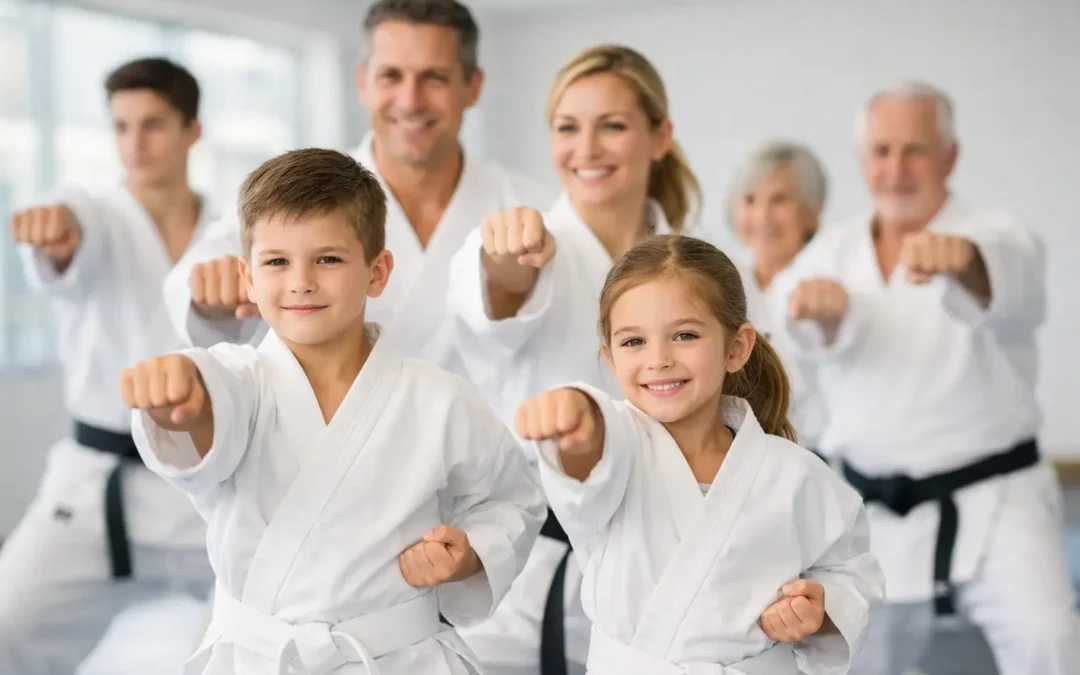
A busy family calendar can make meaningful time together feel scarce. One child has an activity, a parent has a workout goal, and another family member needs a constructive outlet after school. The benefits of family martial arts reach beyond fitting everyone into one building at the same time. With the right instruction, training becomes a shared routine where every family member builds confidence, discipline, fitness, and practical skills at an appropriate level.
Martial arts is not about expecting a six-year-old and an adult to train exactly alike. It is about creating a family culture that values effort, respect, and steady improvement. Children, teens, and adults each have different goals, but they can still encourage one another through the same journey.
1. Family Martial Arts Creates a Routine Worth Keeping
The strongest family routines are not always the easiest to start. They are the ones that give people a reason to return. Martial arts classes provide structure: there is a scheduled time to show up, a clear lesson to practice, and a goal to work toward at the next class.
For children, that consistency reinforces responsibility. They learn that progress comes from attending regularly, listening carefully, and practicing skills even when something feels difficult. For adults, a scheduled class can protect training time that might otherwise disappear into work, errands, and screen time.
When family members train in the same academy, consistency becomes more natural. A parent does not have to choose between supporting a child’s activity and making time for their own health. The family has a positive place to go together, even if each person attends an age-specific or skill-specific class.
2. Confidence Grows Through Earned Progress
Confidence is often treated like something a child either has or does not have. In martial arts, confidence is built through evidence. A student learns a stance, improves coordination, remembers a sequence, earns a new rank, or handles a challenging drill with more control than before. Those moments add up.
Children learn to speak up and stay composed
A child who is quiet in a new setting may begin by practicing eye contact, responding clearly to an instructor, and working with a partner. These are small actions, but they matter. Over time, students often become more willing to participate at school, meet new people, and handle unfamiliar situations without shutting down.
Parents have a unique opportunity to reinforce that growth. Rather than praising only a belt or competition result, they can recognize the work behind it: showing up after a hard day, trying again after a mistake, or demonstrating respect during a difficult lesson.
Teens gain a healthy place to challenge themselves
Teenagers need real challenges, not empty encouragement. Martial arts gives them measurable standards and direct feedback in an environment built on respect. Brazilian Jiu-Jitsu, wrestling, and Tae Kwon Do can teach teens how to remain calm, think clearly, and recover when a technique does not work the first time.
That experience can be especially valuable for teens who are not drawn to traditional team sports. They can improve at their own pace while still being part of a committed community.
3. Fitness Becomes More Engaging Than Another Workout
A standard workout can feel repetitive when there is no skill to learn. Martial arts combines conditioning with purpose. Students develop strength, mobility, balance, coordination, endurance, and body awareness while working toward techniques they can apply and improve.
For adults, this can make training easier to sustain. A class may include drilling, controlled partner work, movement practice, and conditioning, so the mind stays engaged as the body works. For children, martial arts provides an active alternative to long periods spent sitting at school or at home.
The physical demands should match the student. A younger child needs instruction that emphasizes coordination, safe movement, listening, and basic control. An adult may want a more demanding fitness challenge or practical self-defense training. A quality academy adjusts the training environment rather than using a one-size-fits-all approach.
4. The Benefits of Family Martial Arts Include Practical Safety Skills
Families often seek martial arts because they want greater confidence around personal safety. Practical self-defense starts with awareness, boundaries, posture, and decision-making. Physical techniques matter, but they should be taught alongside judgment and self-control.
Students learn that the goal is not to prove toughness or seek conflict. The goal is to recognize problems early, communicate clearly when possible, and protect themselves if they cannot safely leave a situation. This is a valuable message for children, teens, and adults alike.
Training also helps students become more comfortable with controlled pressure. In Brazilian Jiu-Jitsu or wrestling, for example, students learn how to manage position, balance, and movement with a partner. In striking-based training, students build distance management, coordination, and discipline. Certified instruction and closely supervised classes are essential, particularly for beginners and young students.
5. Discipline Carries Into Home and School
Martial arts discipline is not harshness. It is the ability to do what needs to be done with attention and respect. Students learn to line up, follow directions, care for their equipment, control their energy, and treat training partners properly.
Those habits can support everyday life. A child may become more prepared for school, more patient with siblings, or more willing to finish responsibilities before moving on to entertainment. An adult may find that regular training improves stress management and makes it easier to maintain personal goals.
Families should not expect a martial arts class to instantly solve behavior challenges. No program can replace consistent parenting, communication, or support when a child is struggling. But a structured training environment gives parents useful language to reinforce at home: focus, respect, effort, and accountability.
6. Families Build Stronger Connections Through Shared Goals
Family activities are often passive. Everyone may be in the same room, but each person is focused on a separate screen. Martial arts creates conversation and shared investment. A child can show a parent a new technique. A teen can encourage a sibling before a belt test. A parent can model perseverance by attending class even as a beginner.
This matters because children notice what adults prioritize. When parents pursue a skill, accept coaching, and keep practicing, they show that learning does not end after school. That example can be more powerful than a lecture about discipline.
At the same time, family training should leave room for each person’s independence. Some students will love the social side of class, while others prefer to focus quietly on their own progress. The goal is shared support, not pressure to perform at the same speed.
7. A Positive Academy Community Gives Families Support
The environment matters as much as the curriculum. Families should look for an academy where instructors set clear expectations, beginners are welcomed, and students are treated with respect. A strong martial arts community celebrates progress without creating an intimidating atmosphere.
For parents, that means knowing their child is being coached by professionals who value safety and character. For adults, it means joining a class where asking questions is encouraged and improvement is taken seriously. At United Martial Arts Katy, students can explore age-appropriate instruction across disciplines while building skills in a family-friendly setting.
What to look for before your family starts
A free trial class is a practical way to see whether an academy is the right fit. Watch how instructors correct students, how more experienced members treat beginners, and whether the class has a clear structure. Ask which program best matches each family member’s age, goals, and current fitness level.
It is also wise to be realistic about scheduling. A program only delivers long-term benefits if your family can attend consistently. Start with a pace that feels manageable, then let the routine grow as training becomes part of your week.
The best first step is simply to put your family on the mat and pay attention to what changes. A child may stand taller after class. A teen may find a challenge that feels worthwhile. An adult may leave with more energy than they expected. Give those small wins time, and they can become a lasting family standard for discipline, honor, and excellence.


Recent Comments