

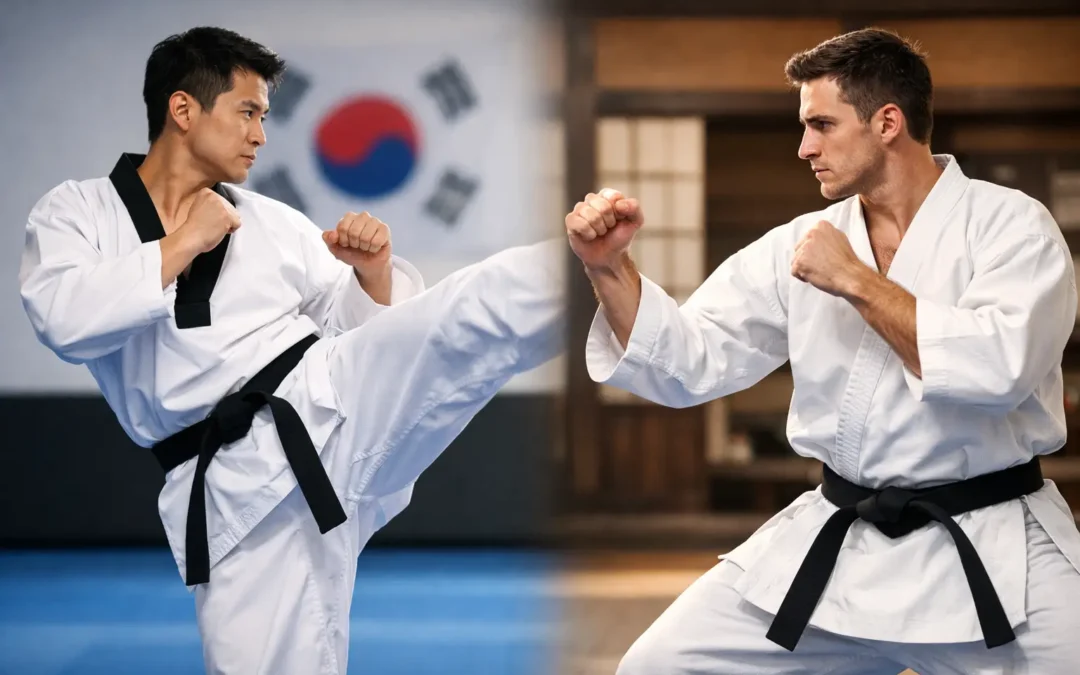
A child who loves fast, high kicks may feel at home in Tae Kwon Do. An adult who wants compact strikes and close-range defense may prefer karate. But the tae kwon do vs karate decision is not as simple as picking “kicks” or “punches.” The right program is the one that builds real skill while helping the student show up, work hard, and grow with confidence.
Both arts can improve fitness, focus, self-control, and practical self-defense awareness. Both use structured classes, belt progression, forms, sparring, and clear expectations for respect. Their differences matter, though, especially for parents choosing a first activity for a child or adults looking for training they will enjoy long enough to make meaningful progress.
Tae Kwon Do vs Karate: The Core Difference
Tae Kwon Do is a Korean martial art known for dynamic kicking, speed, mobility, and athletic movement. Students commonly train a wide range of high, turning, jumping, and spinning kicks. The art asks practitioners to develop balance, flexibility, timing, and the ability to control distance.
Karate is a broad term for Japanese and Okinawan martial arts, and individual karate styles can look quite different. In general, karate places strong emphasis on powerful hand strikes, stable stances, direct movement, and disciplined body mechanics. Kicks are part of karate training, but they are usually less central to the curriculum than they are in Tae Kwon Do.
That is the useful starting point, not the whole story. A school’s teaching quality, safety standards, class culture, and instructor mentorship can have a greater effect on a student’s experience than the name of the style on the door.
How Tae Kwon Do Training Feels
Tae Kwon Do classes often feel energetic and athletic. Students work on chambering the leg correctly, pivoting the supporting foot, extending the kick with control, and recovering to a balanced stance. Because kicks travel farther than punches, students also learn how to manage range and react quickly.
For children, the visual appeal is immediate. Learning to perform a clean roundhouse kick or a controlled jumping technique can be exciting, and that excitement gives instructors a powerful opportunity to teach patience and responsibility. A kick only looks sharp when the student listens, practices fundamentals, and develops control.
For teens and adults, Tae Kwon Do can be an excellent full-body workout. Repeated kicking drills build hip mobility, leg strength, coordination, cardiovascular endurance, and core stability. Students who spend much of the day sitting often appreciate how much the art challenges balance and movement.
Forms, Sparring, and Discipline
Tae Kwon Do training generally includes forms, often called poomsae, which are planned sequences of defensive and offensive movements. Forms help students practice posture, technique, rhythm, memory, and attention to detail. They also create a clear way to measure progress beyond who can kick the highest or move the fastest.
Sparring may be point-based or continuous, depending on the program. Students use protective equipment and learn to apply techniques with rules, supervision, and control. A quality academy does not confuse hard training with careless training. Safety and respect are part of the skill.
How Karate Training Feels
Karate training often has a grounded, direct quality. Students spend significant time developing punches, blocks, strikes, stances, and movement patterns that create power without wasted motion. A beginner may practice the same basic punch many times, learning how the feet, hips, torso, and hand work together.
This attention to fundamentals is one reason karate has such lasting appeal. It can give students a strong sense of structure. Each stance has a purpose. Each strike has a target. Each drill reinforces the ability to stay composed and precise under instruction.
Karate also uses forms, commonly called kata. Like Tae Kwon Do forms, kata develop coordination, memory, body positioning, and discipline. Many karate programs include partner drills and sparring, though the contact level and rules vary significantly by style and school.
The Practical Self-Defense Question
Parents and adults often ask which art is better for self-defense. The honest answer is that either can provide valuable self-defense foundations when taught well. Students learn awareness, distance, balance, assertiveness, and the confidence to act with purpose instead of freezing.
At close range, karate’s emphasis on hand techniques and stable positioning may feel especially practical. At longer range, Tae Kwon Do’s kicking skill can help a student create distance. Yet a real self-defense situation is unpredictable. The most responsible training teaches students to avoid conflict when possible, recognize danger early, set boundaries, and leave safely rather than treat a confrontation like a tournament.
Which Is Better for Kids?
Neither Tae Kwon Do nor karate is automatically better for every child. The best fit depends on the child’s personality, goals, and the quality of the class environment.
A child who needs a positive outlet for energy may enjoy Tae Kwon Do’s active kicking drills and fast-paced movement. It can be especially rewarding for kids who like physical challenges and visible milestones. A child who benefits from routines, careful repetition, and a more grounded approach may connect strongly with karate.
In either art, parents should look beyond a single trial class. Watch whether instructors set clear expectations, correct students respectfully, and make beginners feel capable without making the class too easy. Character development does not come from a belt alone. It comes from consistent coaching, accountability, and a community where effort is recognized.
Which Is Better for Teens and Adults?
Teens often thrive in a program that gives them both challenge and belonging. Tae Kwon Do can be an excellent choice for students who want a demanding athletic outlet, want to improve flexibility, or enjoy the goal of competition. Karate may appeal to teens who value technical detail, self-defense concepts, and the satisfaction of refining strong fundamentals.
For adults, the decision often comes down to the training experience they want to repeat each week. If you enjoy mobility, quick footwork, and powerful kicking combinations, Tae Kwon Do may keep you motivated. If you prefer a style centered on hand techniques, body mechanics, and controlled, direct movement, karate may be a better match.
Fitness level should not stop anyone from starting. A well-run beginner class scales drills appropriately and teaches correct mechanics before asking for speed or intensity. Progress comes from consistency, not from trying to perform advanced techniques on day one.
What to Look for Beyond the Style
The Tae Kwon Do vs karate comparison should lead to a more useful question: where will you receive excellent instruction? A student can learn more in a supportive, well-organized program than in a class that has an impressive style name but weak coaching.
Look for certified instructors who can explain why a technique works, not just demonstrate it. Ask how beginners are introduced to sparring, how the academy handles safety, and how students advance through the ranks. Parents should also notice whether older students model respect for younger students and whether the class builds confidence without encouraging arrogance.
At United Martial Arts Katy, the goal is not simply to teach techniques. It is to help students develop discipline, honor, confidence, and the resilience to keep working when progress feels difficult. Those habits serve students at school, at work, at home, and far beyond the mat.
A first class can answer questions that videos and comparisons cannot. Notice which movements feel exciting, whether the instructor’s coaching makes sense, and whether you leave wanting to return. The right martial art is the one that challenges you safely, gives you a path forward, and helps you become stronger in body and character.


Recent Comments