

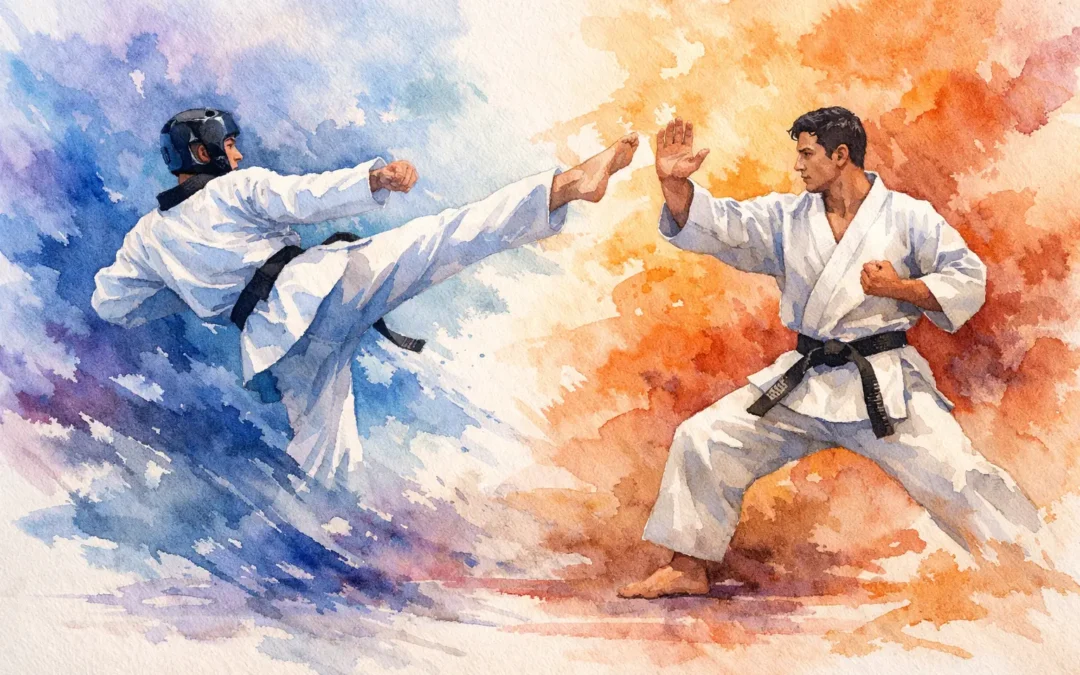
A child snaps a high kick at a target. An adult practices a strong punch and steps out of the way of an incoming strike. From the outside, both can look like “karate.” But the taekwondo vs karate differences become clear as soon as you watch how students move, train, and apply what they learn.
Both arts can build confidence, discipline, coordination, fitness, and practical self-defense awareness. Both can be excellent choices for children, teens, and adults. The better option is not the one with the flashiest kick or the most familiar name. It is the one that matches a student’s goals, personality, and commitment to consistent training.
Taekwondo vs Karate Differences at a Glance
Taekwondo is a Korean martial art known for dynamic kicking, fast footwork, and an athletic range of motion. Karate developed in Okinawa and Japan and is widely associated with powerful hand techniques, grounded stances, and direct movements. Those descriptions are useful, but they are not the entire story.
Each art has multiple styles and organizations. A karate school may place a strong emphasis on sparring, traditional forms, or practical self-defense. A taekwondo school may focus on Olympic-style sport sparring, traditional patterns, breaking, or self-defense drills. The instructor and curriculum matter as much as the label on the uniform.
Still, students will usually notice several consistent differences in how the arts are taught.
Kicking Is Central in Taekwondo
Taekwondo students generally spend more time developing kicks at every level. Front kicks, roundhouse kicks, side kicks, hook kicks, spinning kicks, and jumping kicks are not reserved for advanced demonstrations. They are part of the art’s everyday language.
That emphasis develops balance, flexibility, timing, hip mobility, and body control. It can be especially motivating for students who enjoy movement, athletic challenges, and visible progress. A beginner may not throw a perfect head-height roundhouse on day one, but regular practice gives them clear goals to work toward.
Karate includes kicks too, often including front kicks, round kicks, side kicks, and low-line kicks. In many karate systems, though, kicks are more likely to support hand strikes and positioning rather than dominate the exchange. Karate training often favors efficient, stable techniques over elaborate movement.
Karate Often Gives More Attention to Hand Strikes
Traditional karate commonly spends significant time on punches, blocks, open-hand strikes, elbows, and close-range defensive motions. Students learn to generate power through stance, hip rotation, posture, and sharp technique.
That does not mean taekwondo ignores punches. Students train punches, blocks, and self-defense skills, particularly in traditional taekwondo programs. However, its sparring rules and competitive identity often make kicking the more visible feature.
For a student who naturally enjoys strong hand techniques and close-range training, karate may feel like a more immediate fit. For someone who wants to build speed, flexibility, and explosive leg power, taekwondo may be more appealing. Neither preference is better. They simply lead to different training experiences.
Stances, Movement, and Distance
Karate stances are often lower and more rooted. Training may include deep front stances, horse stances, and strong weight distribution designed to develop stability. The movement can look compact and purposeful, with an emphasis on delivering force while maintaining a solid base.
Taekwondo movement is frequently lighter and more mobile, particularly during sparring. Students learn to manage distance with bouncing footwork, quick angles, and fast entries and exits. This allows room for kicks, which need more range than a punch or elbow.
These are general tendencies, not rigid rules. A traditional taekwondo class can include deep stances and close-range self-defense. A karate class can train fast, agile footwork. The practical question is what your local program spends the most time practicing.
Forms Teach More Than Memorization
Both arts use structured sequences of movements. In taekwondo, these are often called poomsae or patterns. In karate, they are commonly called kata. Students perform combinations of blocks, strikes, stances, turns, and kicks in a prescribed order.
To an observer, forms can seem like choreography. In a quality program, they serve a larger purpose. Forms teach body mechanics, focus, posture, coordination, memory, breathing, and the ability to perform under pressure. They also give students a measurable path of progress from one belt level to the next.
The visual style is often different. Taekwondo forms may feature more kicking and longer, flowing ranges. Karate kata may place greater emphasis on stance transitions, hand techniques, and close-range applications. Yet both demand attention to detail. A student learns quickly that effort matters, but precision matters too.
Sparring Has Different Rules and Rhythms
Sparring is where many people first notice the strongest contrast. Sport taekwondo, especially Olympic-style sparring, rewards controlled kicks to designated scoring areas. The pace can be fast and tactical, with students using distance, timing, feints, and rapid counters.
Karate sparring varies considerably by style. Some schools use point-style sparring, where a clean technique earns a point and action pauses. Others use continuous sparring or more traditional partner drills. Hand techniques may be more prominent, and the exchange may happen at a closer range.
Competition rules are not the same thing as real-world self-defense. They are training frameworks designed for safety, fairness, and skill development. Good martial arts instruction makes that distinction clear. Students should learn control and sportsmanship while also understanding awareness, boundaries, escape, and when to seek help.
Which Art Is Better for Self-Defense?
The honest answer is that it depends on how it is taught and how consistently the student trains. A martial artist who develops awareness, confidence, distance management, controlled technique, and the judgment to avoid unnecessary conflict gains meaningful self-defense benefits in either art.
For children, self-defense begins long before a physical technique. It includes using a confident voice, recognizing unsafe situations, setting boundaries, and telling a trusted adult. For teens and adults, it also includes learning to stay calm, avoid escalation, and leave when possible.
Physical skills matter, but reliable self-defense training should never create a false sense of security. A quality academy teaches students to protect themselves with judgment as well as technique. That is one reason structured instruction and attentive coaching are so important.
Discipline, Belts, and Character Development
Parents often ask whether taekwondo or karate is better for discipline. Either can be a powerful environment for character growth when the program has clear standards and instructors who hold students accountable with respect.
Students learn to arrive prepared, listen carefully, practice through frustration, and show courtesy to training partners. Belt advancement reinforces the idea that progress is earned over time. It is not simply about attending class or being naturally athletic.
The belt colors, testing requirements, terminology, and uniforms may differ by school. What should not differ is the purpose behind the structure: helping students build habits that carry into school, work, home life, and relationships.
At United Martial Arts Katy, that connection between skill and character is central. Students are challenged to improve physically while learning the discipline, honor, and respect that make martial arts training valuable beyond the mat.
How to Choose Between Taekwondo and Karate
Start with the student, not the style’s reputation. A child who lights up when practicing fast kicks may thrive in taekwondo. A student who enjoys strong stances, precise hand techniques, and traditional detail may connect with karate. Adults should also consider their goals: fitness, flexibility, stress relief, confidence, self-defense, competition, or a meaningful long-term practice.
Then watch a class if possible. Notice whether beginners receive patient instruction, whether students train safely, and whether the instructors know how to motivate without intimidation. Look for a culture where students work hard, support one another, and understand that respect is part of every drill.
A trial class is often more useful than hours of online comparison. The right program should feel challenging but welcoming. Students should leave tired, encouraged, and eager to return.
The best martial art is not the one that wins an argument about style. It is the one that gives a student a place to show up consistently, train with purpose, and become more confident one class at a time.


Recent Comments