

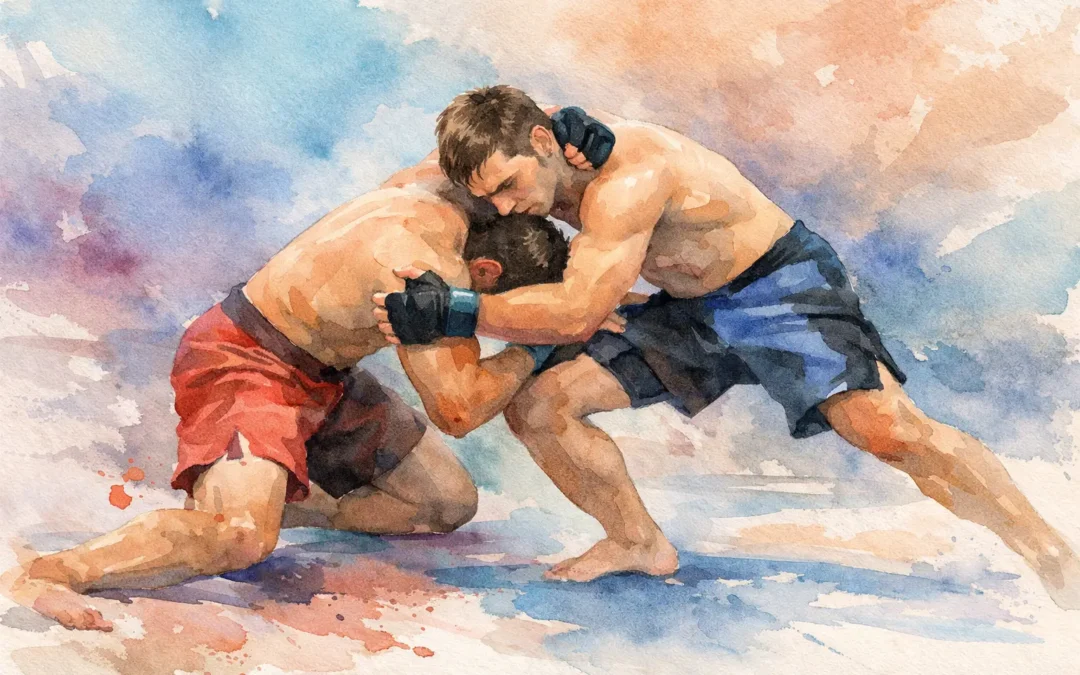
A takedown often succeeds before the shot ever reaches your legs. It happens when your stance gets tall, your hands drift away from the action, or you stay in range without controlling it. Learning how to improve takedown defense starts with recognizing those moments early, then building dependable reactions through disciplined practice.
For children, teens, and adults, good defense is not about being stronger than every training partner. It is about posture, awareness, balance, and the confidence to respond under pressure. Those skills develop over time through safe, structured wrestling and Brazilian Jiu-Jitsu training.
How to Improve Takedown Defense From the Ground Up
The foundation of takedown defense is your stance. If your feet are too close together, your weight is too far forward, or you stand straight-legged, you are easier to move and easier to attack. A sound stance gives you a base that lets you defend, circle, and counter without losing your balance.
Keep your feet about shoulder-width apart, with one foot slightly ahead of the other. Bend your knees, keep your hips underneath you, and stay light enough to move. Your head should be up, your chest should be proud, and your hands should be ready to make contact. You do not need to crouch so low that you cannot move well. The goal is an athletic position that lets you react quickly.
Your stance will vary based on the ruleset and the situation. A wrestling stance may be lower and more aggressive than a stance used in Brazilian Jiu-Jitsu, where you must also consider grips, submissions, and guard pulls. In either case, the principle remains the same: protect your legs while staying balanced enough to move with purpose.
Distance Is Your First Layer of Defense
Many beginners focus immediately on the sprawl. The sprawl matters, but it is often your last line of defense, not your first. Better distance management can prevent an opponent from getting a clean entry in the first place.
When a partner reaches, changes levels, or begins closing space, do not simply back straight up. Step at an angle, circle away from their lead side, and use your hands to create frames or control their shoulders and arms. Straight-line retreat can give a determined opponent exactly the forward momentum they need. Angles force them to reset.
Pay attention to your partner’s level changes. A sudden drop in the hips or knees is often a signal that a shot is coming. Training your eyes to see that cue helps you react before their hands connect behind your legs. This is why live drilling matters: the best defense is not a memorized movement, but a response that becomes natural when the pace changes.
Build a Reliable Sprawl, Not a Panic Reaction
A proper sprawl sends your hips back and down while keeping your chest heavy on your opponent. It takes your legs away from the attack and puts your weight where they do not want it. Done well, it can stop a double leg, slow a single leg, and create an opportunity to establish control.
The common mistake is throwing the legs back without applying pressure. If your hips stay high, or your chest remains upright, the opponent may still drive through and finish. Think about extending your legs behind you while dropping your hips toward their upper back or shoulders. Keep your head up and avoid collapsing your weight onto your neck.
After the sprawl, do not freeze. Use your hands to control the head, shoulders, or arms, then begin to circle. If your opponent is still attached to one leg, work to square your hips, create a whizzer or overhook when appropriate, and turn their head away from your body. Defense becomes much more effective when you immediately move into a position of control.
Sprawling requires careful coaching, especially for younger students and anyone new to grappling. Repeatedly dropping hard onto a partner is not productive training. Start with technical reps at a controlled pace, use proper mats, and increase resistance only as your posture and timing improve.
Win the Hand Fight Before the Shot
Your hands are not decoration. In takedown defense, they are your early-warning system and your first barrier. Good hand fighting keeps an opponent from freely reaching your legs, securing dominant grips, or controlling your head and posture.
Use inside control whenever possible. Keeping your hands and forearms inside your opponent’s arms gives you a stronger path to frame, pummel, and redirect their movement. In wrestling, that may mean fighting for collar ties, biceps control, or wrist control. In Jiu-Jitsu, it may involve managing sleeves, lapels, or no-gi grips while keeping your posture intact.
Do not reach carelessly for the head. Extending both arms too far can expose your legs and pull your weight forward. Instead, make contact with a purpose. Check their shoulders, control a wrist, establish an underhook, or create enough space to move your feet.
Underhooks, Whizzers, and Head Position
When an opponent gets close enough to tie up, inside position becomes even more valuable. An underhook can help you lift their posture, block their forward drive, and turn them away from your legs. Keep the underhook active by staying close, keeping your elbow tight, and using your head position to reinforce the control.
If they attack a single leg and get to the outside of your body, a whizzer, also called an overhook, can help you defend. Drive your hips back, apply pressure through the overhook, and work to turn their head and shoulders away. A whizzer alone is not magic. It works best when combined with strong balance, hip pressure, and movement.
Head position is another detail that makes a major difference. Your forehead should create pressure and alignment, not drop toward the mat. When your head is in a strong position against the side of your opponent’s head or chest, it is harder for them to drive through you cleanly.
Learn to Defend the Second Attempt
A skilled training partner may not finish their first shot, but they may quickly switch to another attack. They might change from a double leg to a single leg, run the pipe on a captured leg, or pull you into a body lock. This is where many students lose position after an initially successful sprawl.
Stay engaged after the first defense. Keep your hips back, fight for an underhook or head control, and move your feet until you have fully cleared the danger. If you defend the legs but allow an opponent to lock their hands around your waist, you still have work to do.
This is also where mat awareness matters. In a self-defense situation, staying on your feet can be valuable because hard surfaces, multiple people, and unpredictable surroundings change the risk. In sport grappling, a takedown may be a scoring exchange that leads into a ground battle. Training should acknowledge both contexts without pretending that one technique solves every situation.
Drill With Purpose, Then Add Resistance
Takedown defense improves fastest when training progresses from clear technique to realistic movement. First, practice the stance, level-change recognition, sprawl mechanics, and basic hand fighting with a cooperative partner. Then add motion, light resistance, and specific rounds where one person attacks while the other focuses on defending and circling out.
A productive session might include stance-and-motion drills, partner reactions to level changes, technical sprawls, pummeling for underhooks, and short live rounds starting from standing. Each drill should have a clear objective. Random effort can make you tired, but focused repetitions build timing.
For parents, the same approach is especially valuable for children. Young students should learn body control, safe falling, balance, and respectful partner work before being asked to perform high-pressure takedown exchanges. Confidence grows when students feel challenged without feeling overwhelmed.
At United Martial Arts Katy, structured instruction gives beginners a path to build these skills with qualified coaching and training partners who understand how to practice safely. The goal is not to win every round on day one. It is to develop composure, discipline, and techniques that hold up as training becomes more demanding.
Make Your Defense Part of Your Mindset
The strongest takedown defense is built before contact. Stay in a disciplined stance. Respect distance. Use your hands. Recognize level changes. When the shot comes, sprawl with purpose, control the position, and keep moving until you are safe.
Progress will not always feel dramatic. One class, you may notice that you saw the shot early. Another day, you may defend the first attempt but lose the scramble afterward. Those are not failures. They are specific lessons that show you exactly what to practice next. Keep showing up, train with intention, and let consistent effort turn defensive awareness into lasting confidence.


Recent Comments