

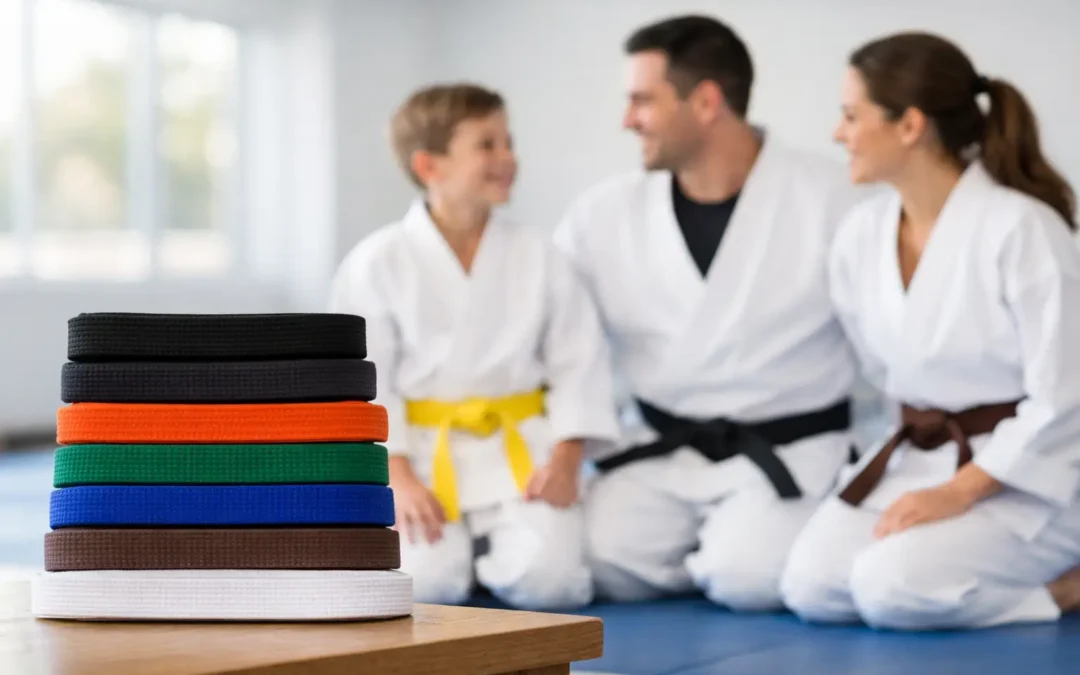
A new belt is not a participation prize. It represents the hours a student has shown up, listened closely, practiced through frustration, and learned to carry themselves with greater control. This martial arts belt progression guide helps parents, children, teens, and adult beginners understand what belts mean, how promotion works, and why steady progress matters more than rushing to the next color.
What Martial Arts Belts Actually Measure
Belts provide a visible path through a skill that can otherwise feel overwhelming at first. A beginner sees a higher-ranked student move with confidence and may assume that ability comes naturally. The belt system shows the truth: skill is built one class, one correction, and one challenge at a time.
A promotion usually reflects more than knowing a set of techniques. In a well-structured academy, instructors consider attendance, effort, technical understanding, physical control, attitude, respect for training partners, and the student’s ability to apply lessons safely. For children, growth in focus, listening, and self-control can be just as meaningful as a sharper kick or a stronger stance.
This is why two students who began at the same time may not test on the same day. Everyone brings different strengths, schedules, learning speeds, and goals to the mat. Belt progression should be consistent and fair, but it should never be a race.
Martial Arts Belt Progression Guide: The Basics
The order of belt colors and the requirements for each rank depend on the martial art and the academy’s curriculum. Tae Kwon Do commonly uses a series of colored belts that lead toward black belt. Brazilian Jiu-Jitsu uses a different system, with adult students generally progressing through white, blue, purple, brown, and black belts. Children’s Brazilian Jiu-Jitsu programs often include additional youth belt colors to recognize age-appropriate development.
That difference matters when families compare programs. A yellow belt in one discipline does not equal a yellow belt in another, and neither is automatically more advanced. The belt represents progress within that specific art’s standards.
A reliable progression system has three qualities: students know what they are working toward, instructors can explain what improvement looks like, and promotions are earned through demonstrated readiness. Clear standards give students direction without reducing training to a checklist.
The beginner stage: Building the foundation
The first belt level is where habits are formed. Beginners learn how to stand, move, fall safely when appropriate, follow directions, use training equipment correctly, and respect the people around them. In striking arts, they may begin with basic stances, blocks, punches, kicks, and combinations. In grappling, the foundation may include safe movement, balance, positional awareness, escapes, and controlled partner practice.
For many adults, this stage is the hardest because being new at something can feel uncomfortable. For children, it can be the first time they are asked to stay focused while developing a physical skill. Progress comes from returning to class, accepting coaching, and practicing the details.
The intermediate stage: Connecting skill and judgment
As students advance, they stop simply memorizing isolated movements. They begin to understand timing, distance, combinations, strategy, and how to respond when a technique does not work perfectly. They also become more responsible training partners.
This is often where confidence becomes visible outside the academy. A child may speak up more clearly, handle disappointment with more maturity, or show greater patience at home. An adult may notice better conditioning, reduced stress, and the satisfaction of working toward a demanding goal. These changes do not happen because of belt color alone. They happen because the student has stayed committed long enough for training to shape their habits.
Advanced ranks: Leadership under pressure
Higher belts carry greater responsibility. Advanced students are expected to maintain strong fundamentals while refining the small details that separate good technique from dependable technique. They may help welcome new students, set a positive example for younger classmates, and demonstrate composure during challenging training.
Black belt is a meaningful milestone, but it is not a finish line. It reflects a deep commitment to learning and a readiness to keep growing. The strongest martial artists remain students of their craft.
What Happens During a Belt Test?
A belt test gives students an opportunity to demonstrate what they have learned in a focused setting. Depending on the program, testing may include techniques, forms or patterns, combinations, self-defense applications, partner drills, physical conditioning, and questions about martial arts values or terminology.
Testing can feel exciting and nerve-racking, especially for a child who does not enjoy being watched. That is part of its value. Students learn how to prepare, perform with focus, recover from a mistake, and finish what they started. Instructors should create a challenging but supportive environment where students are pushed to do their best without being embarrassed for being imperfect.
Not every program uses formal belt tests in the same way. Brazilian Jiu-Jitsu promotions, for example, may rely more heavily on an instructor’s ongoing observation of a student’s sparring, technical development, safety, and consistency. Formal evaluations and day-to-day assessment can both work well when the standards are clear and the instruction is accountable.
How Long Does It Take to Earn the Next Belt?
There is no honest one-size-fits-all timeline. Attendance is a major factor, but time alone does not earn rank. A student who attends regularly, practices with purpose, and responds well to feedback will usually develop more quickly than someone who attends inconsistently.
Age also changes the picture. Young children need time to develop coordination, attention, and emotional regulation. Teens may progress quickly physically but still need guidance in discipline and safe decision-making. Adults can bring excellent focus and determination, yet may need to work around busy schedules, prior injuries, or conditioning limits.
Families should be cautious of programs that promise rapid belts with little emphasis on demonstrated skill. Fast recognition can feel motivating in the moment, but it may leave students without the foundation needed for the next level. At the same time, standards should not be mysterious or used to hold committed students back without explanation. Good instruction balances high expectations with a clear path forward.
How Parents Can Support Healthy Progress
Parents do not need to become martial arts instructors at home. The best support is simple and consistent: help your child arrive on time, make regular attendance a priority, encourage respectful effort, and ask what they learned after class.
Try not to make every conversation about the next belt. Instead, notice the behaviors that create long-term success. Praise your child for returning after a difficult class, paying attention to a correction, or treating a newer student with kindness. Those are signs that martial arts is doing its job.
For adults, the same approach applies. Set a realistic class schedule, track progress by how you feel and perform, and avoid comparing your journey with someone else’s. A belt is earned on the mat, but the discipline behind it can strengthen every area of life.
Choosing a Program With Meaningful Standards
When evaluating a martial arts academy, ask how promotions are determined. A quality program should be able to explain its curriculum, its expectations for testing, and the role of attendance, technique, character, and safety. Watch a class if possible. Notice whether instructors give specific feedback, whether advanced students treat beginners with respect, and whether students are challenged at an appropriate level.
At United Martial Arts Katy, students are guided by certified instruction and a structured path designed to build skill, confidence, and character over time. Whether a student chooses Tae Kwon Do, Brazilian Jiu-Jitsu, wrestling, or private instruction, the goal is not simply to collect belts. The goal is to become more capable, disciplined, and confident with every level earned.
The next belt will come when the work behind it is ready. Until then, show up, train with purpose, and take pride in the progress that no belt can fully measure.


Recent Comments