

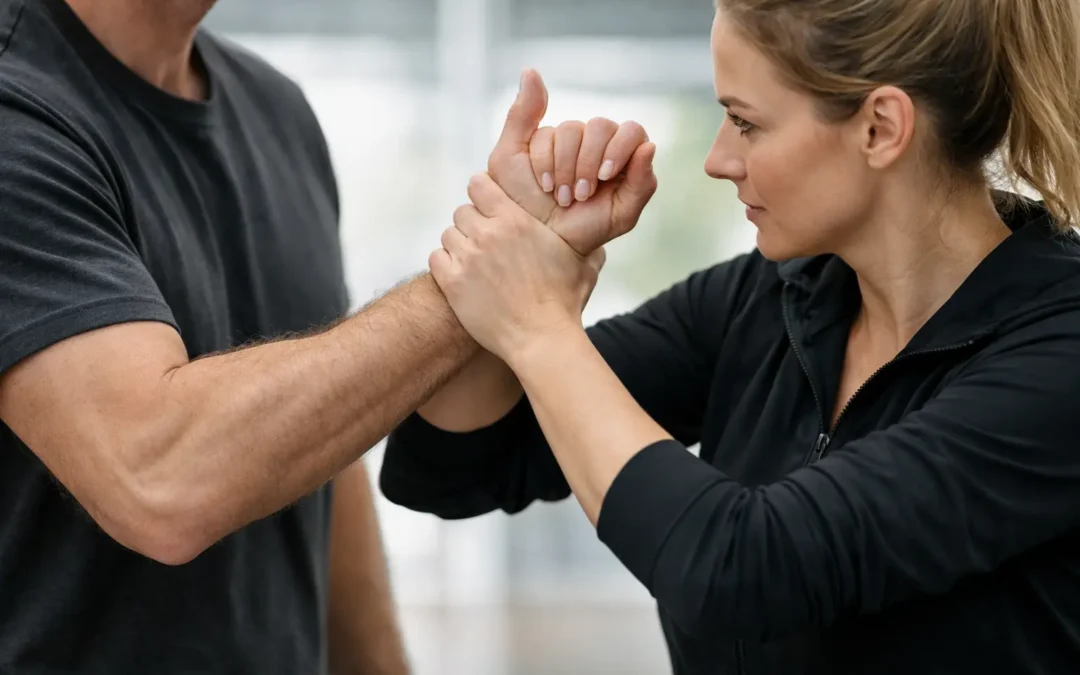
A wrist grab can feel startling because it takes away your freedom of movement before you have time to think. Learning how to escape wrist grabs is not about winning a fight or proving strength. It is about creating space, protecting yourself, and getting away safely when someone tries to control you.
The most useful self-defense skills are simple enough to remember under stress. They rely on body position, balance, timing, and awareness – not complicated moves or the idea that you must overpower another person. With consistent martial arts practice, children, teens, and adults can build the calm, coordination, and confidence to respond with purpose.
How to Escape Wrist Grabs: Start With Leverage
A person holding your wrist may be stronger than you, but their grip has a natural weak point. Their fingers and thumb do not have equal strength in every direction. In many common grabs, the opening near the attacker’s thumb is the easiest area to move toward.
Instead of pulling straight backward against the grip, turn your wrist so the narrow side of your hand moves toward the space between the attacker’s thumb and fingers. At the same time, take a small step backward or at an angle. This combines your body movement with the rotation of your wrist, making the escape more effective than trying to yank your arm free.
Keep your elbow relatively close to your body as you move. A straight, fully extended arm can be easier for someone to control. A bent arm gives you better structure and helps you stay balanced.
The goal is not to stand still and force an escape. Move your feet, turn your body, free your wrist, and create distance. Once you are clear, leave the area and seek help.
Use Your Whole Body, Not Just Your Arm
One of the biggest mistakes beginners make is treating a wrist grab as an arm-strength problem. It is a body-position problem. Your feet, hips, shoulders, and posture all affect whether you can move effectively.
Start by establishing a stable stance. Place one foot slightly behind the other, soften your knees, and avoid leaning too far forward. This gives you a stronger base and makes it harder for someone to pull you off balance.
Then move in a direction that improves your position. Stepping back may create immediate distance. Stepping diagonally can take you off the line of the grab and make it harder for the other person to keep control. Which option works best depends on where the person is standing, how they are holding your wrist, and what obstacles are around you.
If the grab is firm, use your free hand to support the escape. You can place it over your grabbed hand, reinforce your grip on your own hand or wrist, and use both arms together as you turn toward the weak point of the hold. Using two hands gives you more control without requiring you to strike or rely on size.
If Someone Grabs One Wrist
For a single-hand wrist grab, avoid jerking away in panic. First, identify where the attacker’s thumb is. Turn your hand so your thumb-side edge is oriented toward that opening, step or pivot, and pull your arm back toward your own body rather than directly away from theirs.
Think of the motion as turning and withdrawing, not tugging. Your body should move with your wrist. As soon as your hand is free, put distance between yourself and the person.
If Someone Grabs Both Wrists
A two-wrist grab can feel more restrictive, especially for a child or smaller adult. Keep your elbows bent, lower your center of gravity slightly, and avoid allowing your arms to be stretched out in front of you.
Look for a path toward one side of the grip rather than trying to break both hands apart at once. Step to an angle and turn your body so one wrist can move toward the gap near a thumb. Freeing one hand may be enough to create the opening you need to move away, call for help, or draw attention.
If the Grab Includes Pulling
When someone grabs your wrist and pulls, resisting directly can pull you into their space. Instead, stabilize your stance and move with control. A short step may help you regain balance, but do not follow the person farther than necessary.
Turn your body, keep your posture upright, and work toward freeing the wrist while moving toward an exit or other people. In a real situation, awareness of your surroundings matters as much as the technique itself.
Your Voice Can Create an Opening
Physical movement is only one part of self-defense. A clear, firm voice can draw attention, set a boundary, and disrupt a person’s attempt to control you. Depending on the situation, use direct words such as, “Let go,” “Back up,” or “I need help.”
For children, practicing a strong voice is particularly valuable. Many children freeze because they have been taught to be polite to adults. They need to understand that personal safety comes before politeness. A child does not need permission to move away from unwanted contact, make noise, and find a trusted adult.
There are situations where verbal de-escalation is safer than physical resistance, especially if the person is known to you or the environment makes escape difficult. Every circumstance is different. The priority remains the same: reduce danger, get to safety, and contact emergency services when there is an immediate threat.
Why Practice Matters More Than Memorizing
Reading about a wrist-grab escape can help you understand the idea, but stress changes how the body reacts. Fine motor skills can disappear when adrenaline rises. That is why quality instruction emphasizes repeatable movements, sound posture, and practice at a controlled pace.
A good class begins slowly. Students learn where to place their feet, how to protect their balance, and how to use leverage without hurting a training partner. As confidence grows, they can practice with different grip strengths, angles, and realistic verbal pressure while maintaining clear safety rules.
Training also teaches an often-overlooked skill: recognizing when a technique is not working. If a wrist does not come free immediately, do not become fixated on forcing the same motion. Change your angle, use your free hand, move your feet, make noise, and look for a path away. Adaptability is more valuable than a perfect-looking technique.
At United Martial Arts Katy, structured instruction gives students a safe place to develop these skills alongside discipline, respect, physical conditioning, and situational awareness. Beginners do not need previous experience to start building practical confidence.
A Simple Way to Practice Safely at Home
Practice should never become rough play. Work only with a trusted partner, agree on a light grip, and stop immediately if either person feels pain or discomfort. The purpose is to develop movement patterns, not test how hard someone can hold on.
Start with a light single-wrist grab. Practice identifying the thumb side, rotating your wrist toward the opening, stepping back at an angle, and releasing with control. Then reset. Repeat on both sides so your body learns the movement evenly.
As you improve, add a verbal boundary before the escape. Say “Let go” in a firm voice, move, release, and take several steps away. This reinforces the complete self-defense response: communicate, escape, create distance, and seek support.
Parents should avoid teaching children that every unwanted touch requires a physical response. Encourage them to trust their instincts, use their voice, leave when possible, and tell a trusted adult. Martial arts training can reinforce those lessons in an organized environment with experienced guidance.
Build Confidence Before You Need It
The best time to learn self-defense is before a frightening moment happens. Wrist-grab escapes are valuable because they teach a larger lesson: you are not powerless when someone tries to control your movement. Good posture, clear boundaries, smart footwork, and practiced technique can give you options.
Practice with care, stay aware of your surroundings, and remember that success means getting home safely. Confidence grows one controlled repetition at a time.


Recent Comments