

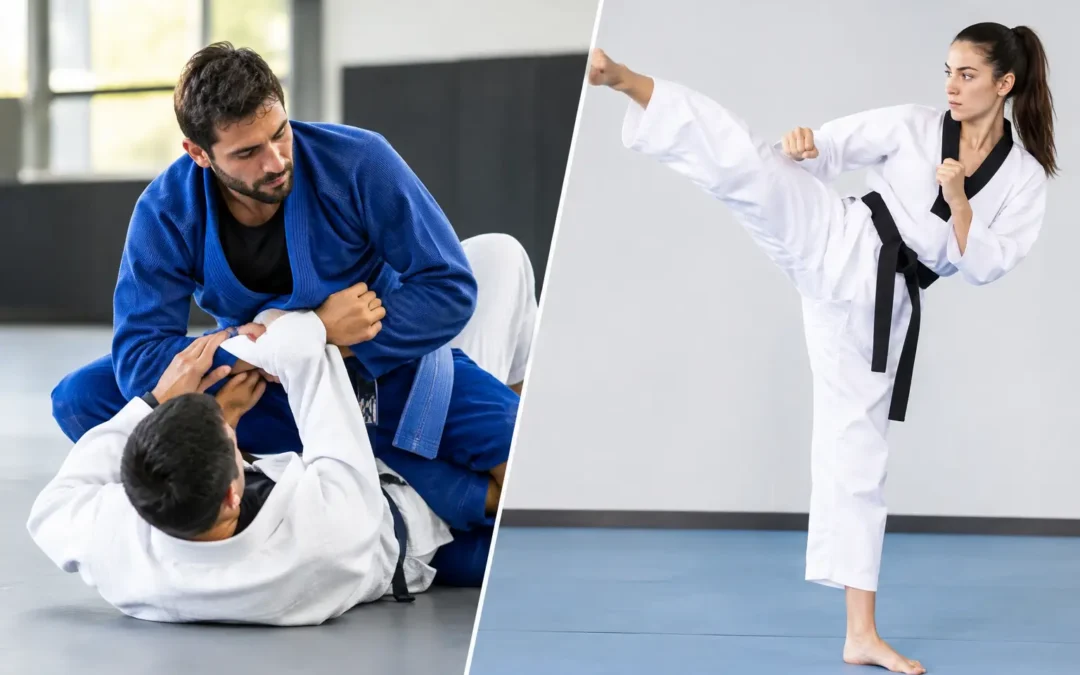
A hard round on the mats can leave an adult gasping after five minutes. A focused Tae Kwon Do class can make that same student realize how quickly balance, hip mobility, and leg endurance fade under repeated kicks. That is the real question behind BJJ versus taekwondo fitness: not which art is tougher, but which kind of training will help you become stronger, healthier, and more consistent.
Both Brazilian Jiu-Jitsu and Tae Kwon Do build meaningful fitness. Both also develop confidence, discipline, and practical awareness. Their physical demands are different enough, however, that the better choice depends on what you want your body to do, what keeps you motivated, and where you are starting.
BJJ Versus Taekwondo Fitness at a Glance
Brazilian Jiu-Jitsu is close-contact training. Students learn to control position, escape pressure, apply holds, and solve problems while another person actively resists. Fitness develops through drilling, grappling rounds, transitions, grip fighting, and the repeated effort of moving your body and a training partner’s body.
Tae Kwon Do is built around striking technique, footwork, stances, kicking combinations, forms, and controlled sparring. Students train timing, range, posture, speed, and precise movement. Its conditioning often feels more upright and explosive, especially through the hips, legs, and core.
Neither system is automatically a better workout. An energetic beginner BJJ class and a technical Tae Kwon Do class may produce very different levels of fatigue on a given day. Quality coaching, class structure, your effort, and your current conditioning all matter. Over time, though, each discipline tends to shape fitness in distinct ways.
How BJJ Builds Functional Strength and Endurance
BJJ challenges the body from positions most gym workouts do not replicate. You may be pulling, framing, bridging, shrimping, posting on one arm, standing up under pressure, or maintaining posture while someone tries to break it. The result is a demanding blend of strength, muscular endurance, body control, and problem-solving.
Grip strength is one of the first changes many students notice, particularly in a gi program. Your back, forearms, shoulders, hips, and core are constantly involved. But BJJ is not simply about muscling through a round. Good technique teaches students to use leverage, angles, timing, and relaxed movement so they do not waste energy.
That lesson is valuable for adults who have trained hard in the past but want a more engaging alternative to repetitive workouts. You are working intensely, yet your attention is on the next escape, sweep, pass, or control position. The mental focus can make conditioning feel less like a chore.
Cardiovascular demand in BJJ is often unpredictable. A student might spend several seconds working explosively to escape a bad position, settle into controlled movement, then need another burst of effort. This stop-and-start pattern can build strong conditioning, but it can also expose weaknesses quickly. Beginners commonly fatigue because they tense every muscle, not because they are incapable of learning BJJ.
For children and teens, BJJ can improve coordination, spatial awareness, balance, and resilience. They learn to stay calm when a situation is uncomfortable, follow safety rules, and work respectfully with training partners. Those character benefits matter just as much as the physical ones.
What BJJ May Not Emphasize as Much
BJJ does not naturally provide the same volume of high kicks, long-range footwork, or upright striking movement as Tae Kwon Do. It can improve mobility, especially in the hips and shoulders, but flexibility is not guaranteed. Students who want exceptional kicking range or dynamic leg speed may need dedicated mobility work alongside their mat training.
Because BJJ involves close contact, students must also be comfortable with a gradual adjustment period. A well-run academy teaches safe tapping, controlled intensity, hygiene, and partner awareness. Still, it is a personal sport. If you strongly dislike grappling or being in close quarters, you are less likely to stay consistent long enough to gain its fitness benefits.
How Tae Kwon Do Develops Speed, Mobility, and Cardio
Tae Kwon Do fitness begins with movement quality. A student learns to hold stances, shift weight, chamber a kick, rotate through the hip, maintain guard, and return to balance. These details make a class physically demanding even before sparring or conditioning drills begin.
The legs do significant work. Repeated front kicks, round kicks, side kicks, and combinations build endurance through the quads, glutes, calves, and hip stabilizers. The core has an equally important job, helping transfer force while keeping the body aligned. Over time, students often gain better balance, quicker footwork, stronger posture, and greater awareness of how their body moves through space.
Tae Kwon Do can be an excellent choice for people who want a high-energy workout without the close-contact nature of grappling. Kicking drills, pad work, forms, and controlled sparring can elevate the heart rate while keeping training structured and approachable. For many beginners, the clear progression from basic techniques to combinations and belt advancement is highly motivating.
Flexibility is another meaningful advantage. Tae Kwon Do classes encourage mobility in the hips, hamstrings, and lower body because range of motion supports safe, effective kicking. Students do not need to arrive flexible. In fact, many adults begin with tight hips and limited range. Consistent instruction helps them improve gradually rather than forcing positions their body is not prepared to reach.
What Tae Kwon Do May Not Emphasize as Much
Tae Kwon Do can build impressive leg endurance and cardiovascular fitness, but it does not create the same sustained pulling, gripping, and full-body resistance found in regular grappling. A student seeking maximal upper-body strength may benefit from supplemental strength training or from combining striking practice with another discipline.
It also asks students to respect their current mobility and joint health. High kicks look exciting, but quality comes before height. Certified instruction should emphasize control, balance, proper warmups, and progressive technique, especially for adults returning to exercise after years away.
Which Martial Art Is Better for Weight Loss?
Either art can support weight loss because both make exercise more enjoyable and sustainable than a routine you quit after three weeks. The class that you attend consistently will do more for your health than the workout that appears perfect on paper.
BJJ may feel especially challenging for students who enjoy competitive problem-solving and full-body resistance. Tae Kwon Do may be easier to maintain for students who enjoy rhythmic movement, striking, and visible improvements in flexibility and kicking skill. In both cases, body composition still depends on sleep, nutrition, daily activity, and training frequency. Martial arts are powerful support for healthy habits, not a shortcut around them.
For parents, the same principle applies to children. A child does not need to frame training around calories or weight. The better goal is helping them find a structured activity where they move regularly, build confidence, develop discipline, and feel proud of their progress.
Choosing Between BJJ and Tae Kwon Do for Your Goals
Choose BJJ if you are drawn to self-defense at close range, ground control, problem-solving under pressure, and full-body resistance. It is often a strong fit for adults who want to trade ordinary gym routines for a skill-based challenge. It can also serve teens who need a constructive outlet that rewards patience and composure.
Choose Tae Kwon Do if you want to improve kicking ability, agility, flexibility, balance, and cardiovascular conditioning in a structured setting. It is a natural fit for students who enjoy clear technique, energetic movement, and the confidence that comes from learning to control distance and use their body with precision.
For many families, the answer does not have to be permanent. A child may begin in Tae Kwon Do to build coordination and confidence, then become curious about grappling later. An adult may train BJJ for strength and self-defense while using Tae Kwon Do to sharpen mobility and striking skills. Cross-training can be valuable when it is paced well and supported by recovery.
Start With the Class You Will Return To
The best way to choose is not to watch highlight videos or compare calorie estimates. Step into a beginner-friendly class and pay attention to the coaching. Are techniques explained clearly? Are students corrected with respect? Is the atmosphere challenging without being intimidating? Do you leave feeling accomplished and eager to improve?
At United Martial Arts Katy, students can train in a disciplined, family-focused environment where progress is built through safe instruction, consistent effort, and strong mentorship. A trial class gives you a far more honest answer than a fitness chart ever will.
Your first class does not need to prove that you are already in shape. It simply needs to show you a training path worth committing to, one class, one skill, and one stronger version of yourself at a time.


Recent Comments