

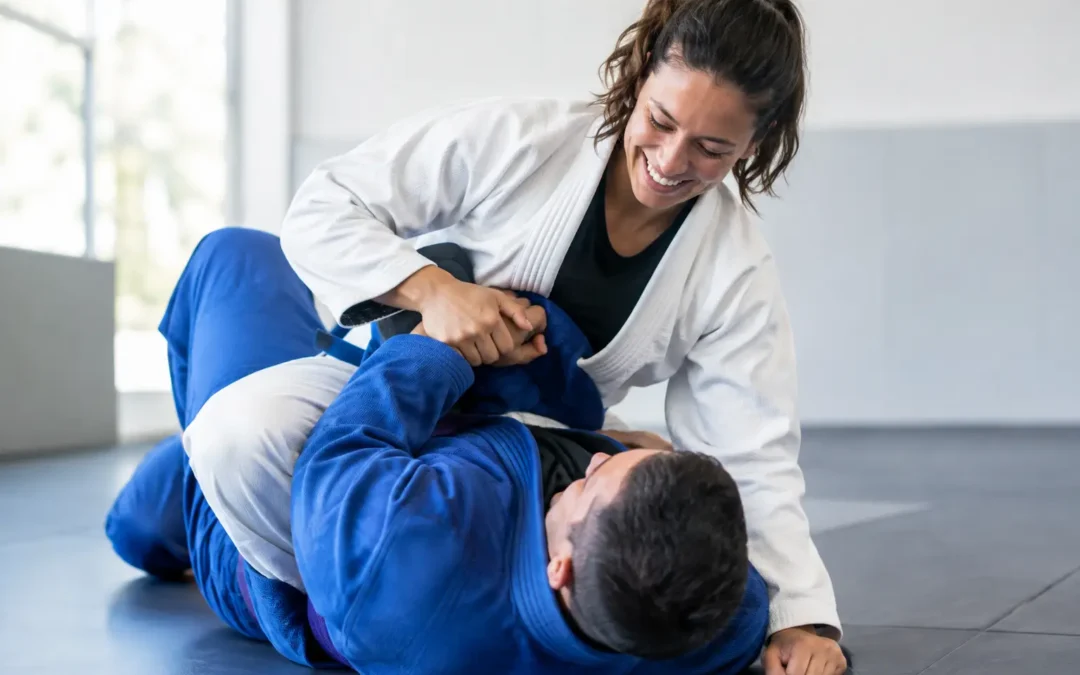
The phrase adult transformed fitness with jiu jitsu is not about a quick body makeover or surviving a punishing workout. It is about building a body that moves with purpose. For adults who feel bored by treadmills, inconsistent with gym routines, or disconnected from their physical potential, Brazilian Jiu-Jitsu offers a demanding, practical reason to show up and improve.
You do not need to be naturally athletic, flexible, or experienced in martial arts to begin. You need qualified instruction, a safe training environment, and the willingness to learn one position, one movement, and one round at a time. Over time, the changes reach well beyond the scale.
How Jiu Jitsu Transforms Adult Fitness
A typical gym workout can be easy to abandon because the goal feels distant. You may know that lifting weights or doing cardio is good for you, but repeating the same routine can feel like a chore. Jiu-Jitsu gives each physical effort a clear purpose: improve your balance, escape a difficult position, control distance, defend yourself, or help a training partner develop.
That purpose changes the experience of exercise. A class may include warmups, drilling, positional practice, and controlled sparring. You are working hard, but your attention is on solving a problem. Many adults find that this makes consistency easier. They return because there is always another skill to sharpen.
The physical conditioning is broad. Jiu-Jitsu asks you to push, pull, brace, rotate, grip, bridge, squat, and move on the ground. It challenges the muscles of the back, hips, legs, shoulders, and core in coordination rather than isolation. It also develops cardiovascular endurance, especially as students become more efficient during live training.
That does not mean every class is an all-out conditioning test. Good instruction balances intensity with technique and recovery. Beginners should not feel pressured to prove toughness on day one. The goal is sustainable progress, not exhaustion for its own sake.
Strength that works under pressure
Jiu-Jitsu develops functional strength because you must connect your body to a real task. A bridge is not just an exercise for your hips. It may create space to escape from underneath an opponent. A strong grip is useful, but posture, leverage, and timing often matter more.
This is encouraging for adults who assume they need to get fit before trying martial arts. In fact, learning correct mechanics is part of getting fit. A smaller student using structure and technique can often manage situations that raw strength alone cannot solve. Strength still helps, but Jiu-Jitsu teaches you how to apply it intelligently.
Better mobility, balance, and body awareness
Many adults spend long hours sitting at a desk, driving, or looking down at a screen. Tight hips, stiff shoulders, poor balance, and limited range of motion can gradually become normal. Jiu-Jitsu training brings attention back to how the body moves.
Shrimping, bridging, technical stand-ups, guard movement, and controlled ground transitions ask students to use ranges of motion that daily life often neglects. With proper coaching and a sensible pace, students commonly gain a better awareness of posture, balance, and where their body is in space.
Mobility gains are not automatic. Someone with a prior injury, chronic pain, or significant limitations should speak with a medical professional and inform the instructor before training. A quality academy can provide modifications and help a new student learn safely, but smart training always respects individual limits.
Why Adult Fitness Changes More Than Your Body
The most meaningful transformations often begin when a new student realizes that progress is earned, not handed over. In Jiu-Jitsu, everyone starts somewhere. There will be moments when a technique does not work, a round feels difficult, or a more experienced partner exposes a gap in your defense.
That is not failure. It is feedback.
Adults often carry the pressure of being competent in their work, family life, and social circles. Beginning Jiu-Jitsu can feel humbling because you are learning in public. Yet that humility becomes a strength. You learn to stay calm, listen closely, adjust, and try again. Those habits build resilience that carries into life outside the academy.
Confidence built through evidence
Real confidence is not loud. It is the quiet knowledge that you can remain composed when something is unfamiliar or uncomfortable. Each class gives adults small pieces of evidence: you remembered the sequence, you improved your position, you trained another round without quitting, or you helped a newer student feel welcome.
This matters for self-defense as well. Jiu-Jitsu does not promise that every dangerous situation can be controlled. The safest choice is always to avoid danger and leave when possible. Still, training can give adults a stronger understanding of distance, balance, control, and how to respond if a physical confrontation cannot be avoided.
Stress relief with structure
After a full day of work, family responsibilities, and constant notifications, many adults need more than another screen-based distraction. Jiu-Jitsu demands presence. During drilling or sparring, your focus narrows to breathing, position, movement, and the person in front of you.
That concentration can be deeply restorative. You leave class physically tired, but mentally clearer. The academy also becomes a place where professionals, parents, students, and neighbors work toward a shared challenge. For many adults, that supportive community is as valuable as the workout itself.
What a Beginner Should Expect
The first few weeks can feel awkward. You will learn unfamiliar vocabulary, practice movements that are new to your body, and discover that even simple techniques have details. That learning curve is normal. A beginner-friendly program should make the process clear rather than intimidating.
Expect coaches to teach foundational positions, safe falling and movement patterns, basic escapes, control concepts, and etiquette. Training partners should work with control. A good partner does not treat a new student like a target. They help create a safe environment where both people can learn.
You also do not have to train like a competitor to benefit. Some adults enjoy frequent classes and eventually pursue tournaments. Others train two or three times per week for fitness, confidence, self-defense, and community. Both approaches are valid. The right schedule is the one you can maintain while balancing recovery, work, and family.
Make Jiu Jitsu Part of a Lasting Fitness Routine
Consistency beats intensity that cannot last. Starting with two classes per week gives most beginners enough repetition to learn while allowing time for recovery. As your conditioning improves, you can add sessions based on your goals and schedule.
Support your training with basic habits: sleep enough, drink water, eat meals that help you recover, and avoid treating soreness as a badge of honor. Some people also benefit from strength training or walking on non-Jiu-Jitsu days. The best plan depends on your current fitness level, age, injuries, and how often you train.
At United Martial Arts Katy, adults can learn in a structured setting where certified instruction, respect, and steady progress come first. The point is not to become someone else. It is to become more capable than you were when you started.
Your first class may challenge your lungs, your coordination, and your comfort zone. Keep showing up. A few months from now, the movements that felt impossible can become familiar, and the fitness you wanted may arrive as a result of learning something worth doing.


Recent Comments