

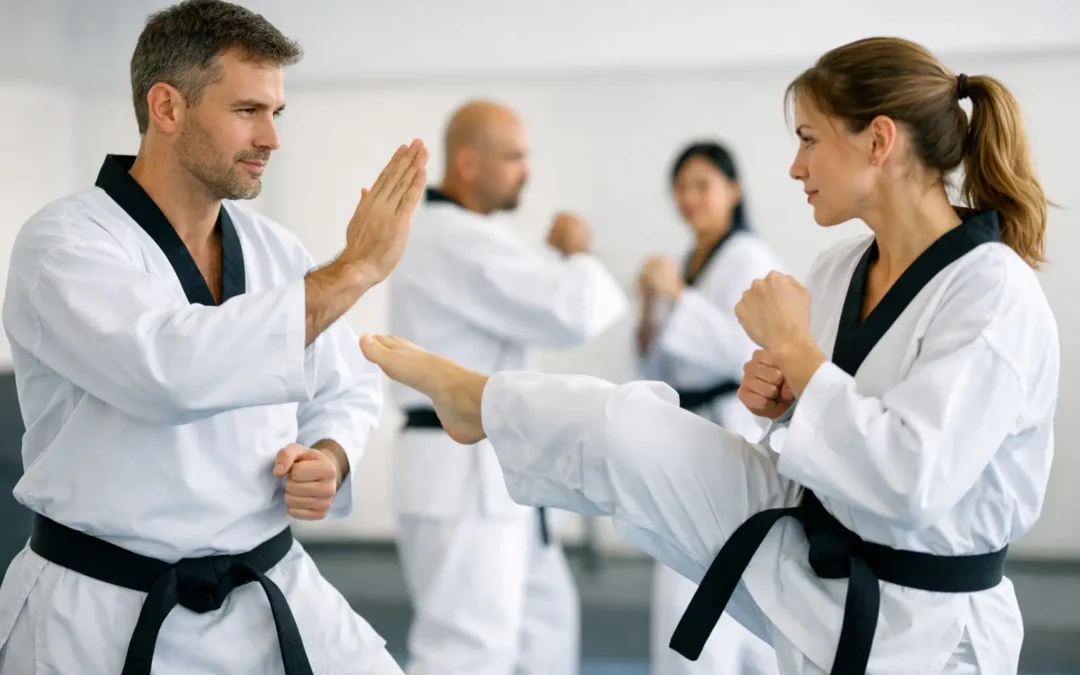
Walking into your first martial arts class can feel more intimidating than the workout itself. You may wonder whether everyone else already knows the forms, whether you are fit enough to keep up, or whether Tae Kwon Do is only for people who started as children. This guide to adult tae kwon do is built around a simpler truth: adults do not need prior experience to train well. They need qualified instruction, consistent effort, and a school where progress is earned one class at a time.
Tae Kwon Do gives adults something many workouts do not: a clear skill path. You are not just burning calories and repeating the same routine. You are learning how to move with balance, create power, defend yourself with control, and carry yourself with greater confidence beyond the mat.
Why Adults Choose Tae Kwon Do
Adults come to Tae Kwon Do for different reasons. Some want practical self-defense. Others are looking for a more engaging alternative to a gym, a way to manage stress after work, or a structured challenge that builds discipline. Many are simply ready to do something for themselves.
The physical benefits are real. Tae Kwon Do develops cardiovascular endurance, leg strength, mobility, coordination, core control, and reaction time. Kicking drills can improve hip flexibility and balance, while combinations and footwork demand focus from the entire body. Because classes vary between technical practice, conditioning, partner drills, and forms, training stays mentally active as well as physically demanding.
Just as valuable is the confidence that comes from measurable improvement. The first time you execute a clean front kick, remember a sequence, or complete a difficult class without stopping, you have evidence that you can improve through disciplined practice. That mindset carries into work, family life, and other personal goals.
What Adult Tae Kwon Do Classes Actually Look Like
A good beginner class is structured, not chaotic. Although each school organizes training differently, a typical adult session begins with a warm-up designed to prepare your joints, muscles, and heart rate. You may practice stances, basic blocks, punches, and kicks before moving into combinations, forms, conditioning, or controlled partner work.
You will not be expected to spar hard on your first day. Sparring is a valuable part of Tae Kwon Do, but it should be introduced at the right pace with safety equipment, clear rules, and instructor supervision. Beginners usually spend time building the fundamentals that make sparring safer and more productive: distance, timing, posture, control, and respect for a training partner.
Forms, sometimes called poomsae, are another core element. A form is a set sequence of techniques performed with attention to stance, direction, breathing, and power. To a new student, forms can seem like memorization. Over time, they become a practical way to refine body mechanics, concentration, and consistency.
Classes should challenge you, but they should also be scaled to your current ability. A certified instructor can offer modifications when a kick height, mobility restriction, old injury, or fitness level requires an adjustment. Pushing yourself matters. Ignoring your body does not.
Your First 90 Days of Training
The early months are about building a reliable foundation, not trying to look advanced. Adults often judge themselves too quickly because they understand what they want their body to do before their body has learned how to do it. Give the process time.
Start with control before speed
Powerful kicks begin with proper chambering, balance, hip position, and a stable supporting leg. Fast punches require alignment and relaxed movement before impact. If you rush to add speed or force, technique usually breaks down. Focus on clean repetitions first. Power develops from correct mechanics.
Attend consistently
For most adult beginners, two classes per week is a strong starting point. It provides enough repetition to build familiarity without overwhelming an already busy schedule. One class per week can still be beneficial, especially at first, but progress may feel slower because your body has less frequent practice.
Consistency does not mean perfection. Work schedules, family responsibilities, travel, and illness happen. The goal is to return to training instead of deciding a missed week means you have failed. Long-term martial arts progress belongs to the student who keeps showing up.
Learn the language of the school
Tae Kwon Do includes terminology, belt expectations, etiquette, and traditions that may be new to adult students. Bowing, lining up, addressing instructors respectfully, and following class procedures are not empty rituals. They create a focused environment where everyone can train safely and learn efficiently.
You do not need to memorize every Korean term immediately. Listen, ask questions, and let repetition do its job. A welcoming school will explain expectations rather than making beginners feel out of place.
How Tae Kwon Do Supports Practical Self-Defense
Tae Kwon Do is well known for dynamic kicking, but adult training should not confuse athletic technique with reckless real-world decision-making. Practical self-defense begins with awareness, confidence, verbal boundaries, and knowing when to leave. Physical techniques are one part of the equation, not the whole plan.
Training can help adults improve distance management, balance under pressure, reaction time, and the ability to generate force with purposeful movement. Partner drills also teach composure. When someone steps toward you, holds a target, or applies a controlled grab, you learn to respond with technique rather than panic.
The trade-off is that self-defense skills require regular practice and responsible instruction. No class can promise that a person will win every confrontation. The stronger goal is to become more alert, more capable, and better prepared to make safer decisions.
Choosing the Right Adult Tae Kwon Do School
The school you choose affects whether you stay motivated long enough to gain the benefits of training. Look beyond the schedule and price. Observe a class if possible and pay attention to how instructors speak to beginners, how advanced students treat newer members, and whether safety standards are clear.
A strong academy has instructors who correct technique without humiliating students. It has a progression system that gives adults meaningful goals while recognizing that people learn at different rates. It also creates a culture where discipline and respect apply to everyone, regardless of belt rank or athletic background.
Ask how beginner students are introduced to sparring, what protective gear is required, and whether instructors can accommodate common limitations. If you have a history of knee pain, shoulder issues, back concerns, or a medical condition, speak up before class. A professional instructor needs that information to help you train wisely.
At United Martial Arts Katy, adult students train in a family-friendly setting where traditional values such as discipline, honor, and respect are paired with clear instruction and achievable progression. The best first step is often a trial class, because the right school should feel challenging, organized, and welcoming from the moment you step onto the mat.
What to Bring and What to Expect
For a first class, wear comfortable athletic clothes that allow you to lift your knees, turn your hips, and move freely. Bring water, arrive a few minutes early, and avoid a heavy meal right before training. Most schools will explain uniform requirements after you decide to enroll.
Expect to sweat, make mistakes, and feel muscles you may not have used in a while. Soreness can be normal when starting a new physical routine, especially in the calves, hips, thighs, and core. Sharp pain is different. Stop and tell your instructor if something does not feel right.
You should also expect moments of frustration. A form may take several classes to remember. Your non-dominant side may feel awkward. A kick that looks simple may demand more balance than you expected. Those moments are part of the training, and working through them is where confidence is built.
Building a Practice Habit Outside Class
You do not need a home gym to support your progress. Five to ten minutes of focused practice can reinforce what you learned in class. Review stances in front of a mirror, practice footwork in a clear space, or perform techniques slowly to improve balance and position. Slow practice is especially useful because it exposes habits that speed can hide.
Mobility work also helps. Gentle hip, hamstring, ankle, and calf mobility can make kicking more comfortable over time. Do not force flexibility by pushing into pain. Sustainable range of motion comes from patient, regular work.
Most of all, protect your mindset. Avoid comparing your first month to another student’s fifth year. Their progress is evidence of what consistent training can produce, not a reason to question your own start. Every black belt once had to learn where to place their feet, how to tie a belt, and how to throw a basic punch.
Your first class is not a test of whether you belong in martial arts. It is a decision to give your body and mind a disciplined place to grow. Show up willing to learn, train with respect, and let each lesson build the confidence for the next.


Recent Comments