
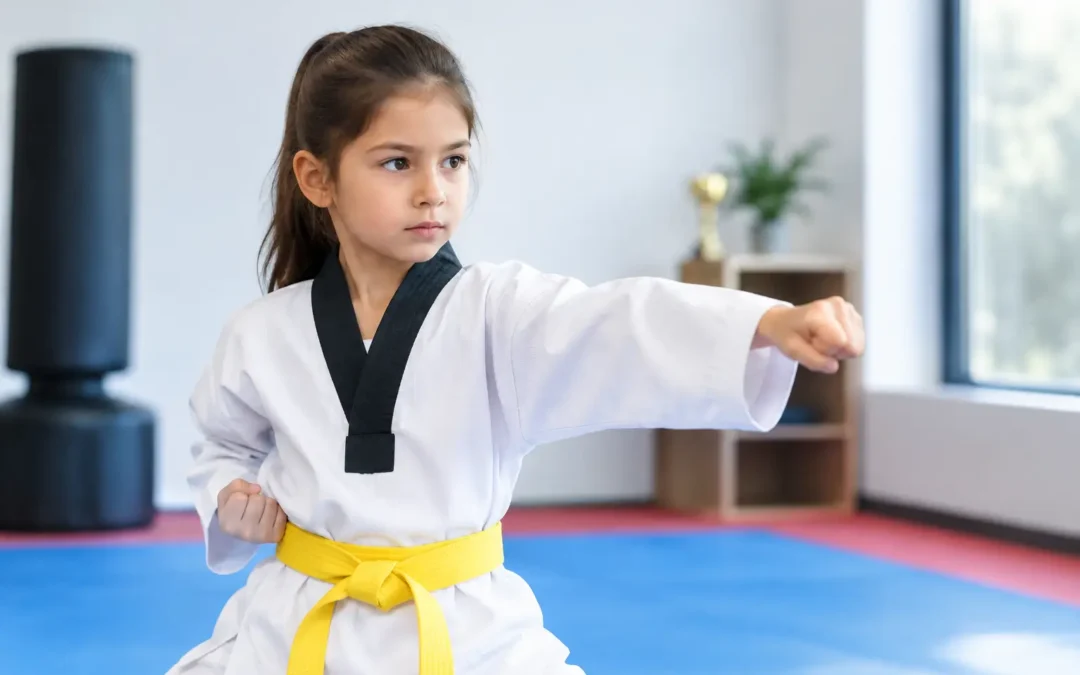
A child steps onto the mat after a long school day. They are energetic, distracted, and still thinking about homework, friends, or the game they played in the car. The instructor calls the class to attention. Feet come together, eyes forward, voices quiet. Within minutes, that same child is practicing a pattern with purpose. This taekwondo focus improvement example shows why martial arts can become a practical training ground for attention, self-control, and confidence.
Focus is not simply the ability to sit still. For children, teens, and adults, it means noticing instruction, controlling impulses, returning attention after a distraction, and finishing the task in front of them. Tae Kwon Do develops these skills through clear structure, repetition, movement, and accountability.
Why Focus Needs Practice, Not Just Reminders
Many parents know the familiar cycle: a child is told to pay attention, does so briefly, then drifts away again. The issue is not always defiance or a lack of ability. Focus is a skill, and skills improve when they are practiced in a setting with clear expectations.
Tae Kwon Do gives students a reason to focus right away. They need to listen for the next command, remember a sequence, maintain proper distance from a training partner, and control their body safely. A missed instruction may mean starting a form over, changing the direction of a technique, or losing the rhythm of a drill. The feedback is immediate, but it is also constructive.
Unlike passive activities, martial arts ask students to engage their minds and bodies at the same time. That combination can be especially helpful for children who have a hard time staying engaged at a desk but respond well to active, purposeful learning.
A Taekwondo Focus Improvement Example in Class
Consider an 8-year-old student who often looks around the room during instruction. At first, they need several reminders to stand in ready position, watch the instructor, and begin when the class begins. During a basic kicking drill, the student throws a strong front kick but forgets the next direction because they are watching another student across the mat.
The instructor does not label the child as inattentive. Instead, they give one clear correction: eyes forward, hands up, listen for the count. The class repeats the drill. This time, the student completes three controlled kicks on command, returns to stance, and waits quietly for the next cue. That is a meaningful win.
Over several weeks, the student practices the same process in different situations. They learn to listen to a sequence of commands before moving. They repeat a form that requires them to remember stance, direction, hand position, and timing. They work with a partner, where focus also means following safety rules and respecting personal space.
Eventually, the student may need fewer reminders. They begin to self-correct when their hands drop or their attention wanders. They can finish a form without stopping to look around. At home, a parent may notice that getting dressed for school, completing a chore, or working through homework takes less repeated prompting. Tae Kwon Do is not a replacement for support at school or at home, but it can reinforce the habits that make focus easier to use everywhere else.
What Makes Martial Arts Different
A good Tae Kwon Do class is structured from the moment students enter the training area. They line up, bow, listen, warm up, practice techniques, and close class with respect. That routine creates predictability. Students know what is expected, and they learn that preparation comes before performance.
The physical nature of training also matters. A student cannot throw a controlled kick while their body is loose and their attention is somewhere else. Balance, posture, breathing, and eye contact all require present-moment awareness. When students see that concentration improves their technique, focus stops feeling like a rule adults repeat and starts feeling like a personal advantage.
Belt progression provides another layer of motivation. Students understand that advancement requires more than athletic ability. They must show respect, remember material, follow directions, and demonstrate consistent effort. Some students progress quickly in physical coordination but need more time with patience or attention. Others may need extra work on a kick but excel at listening and persistence. Both experiences teach that growth comes through practice.
How Instructors Build Attention Safely
Focus should be trained without humiliation. Calling out a distracted child in front of peers may create embarrassment, not discipline. Effective instructors set firm expectations while giving students a path back into the lesson.
A simple correction can be enough: reset your stance, take a breath, watch the demonstration, then try again. This teaches students that losing focus is not failure. The important part is recognizing it and returning to the task.
At United Martial Arts Katy, structured instruction gives beginners a clear starting point while allowing experienced students to keep developing. In a family-friendly class environment, students can be challenged without feeling intimidated. Certified guidance helps ensure that focus, technique, and safety develop together.
For younger children, instructors may use shorter drills and frequent transitions to keep attention active. For teens, the emphasis may shift toward more complex forms, partner work, conditioning, and leadership. Adults often find that class becomes a valuable break from work stress and digital distractions. The method changes with the student, but the habit stays the same: listen, act with intention, reset, and continue.
Bringing the Lesson Home
Parents can support Tae Kwon Do focus training without turning home into another martial arts class. The goal is to use the same clear, calm approach students experience on the mat.
Give one instruction at a time when possible. Instead of saying, “Clean your room, get your backpack ready, and come downstairs,” start with, “Put your shoes in the closet.” When that is finished, give the next step. This is especially useful for younger children or children who become overwhelmed by long directions.
It also helps to praise the process specifically. Rather than only saying, “Good job,” try, “You heard the instruction the first time and finished it,” or, “You got distracted, then came back and completed your homework.” Specific feedback helps children recognize what focused behavior actually looks like.
Consistency matters more than perfection. A child may show excellent concentration in class one day and struggle the next. Sleep, school pressure, hunger, excitement, and changes in routine all affect attention. The aim is not to create a child who never gets distracted. The aim is to help them build the discipline to return to what matters.
The Confidence Behind Better Focus
When a student learns to focus, they gain more than improved listening skills. They experience the confidence of knowing they can handle a challenge one step at a time. They see that a difficult form becomes manageable when they slow down, pay attention, and keep practicing.
That confidence can carry into school presentations, team sports, friendships, and everyday responsibilities. A student who once gave up after one mistake may learn to reset their stance and try again. A teen who feels scattered after school may find a healthy routine that demands their full attention. An adult may discover that an hour of intentional training brings more mental clarity than another hour spent scrolling on a phone.
The strongest results are built over time. One focused class will not change every habit, but repeated practice can shape how a student responds when life gets busy. Each bow, stance, form, and controlled technique offers another chance to practice discipline with purpose.

Recent Comments