

A takedown may last two seconds. The ability to stay calm, control your body, and make good decisions under pressure lasts much longer. That is why families and adult beginners often ask about wrestling versus jiu jitsu training before choosing a program.
Both disciplines build real athletic ability, confidence, discipline, and resilience. They also look very different on the mat. Wrestling rewards urgency, balance, and relentless control from standing positions. Brazilian Jiu-Jitsu teaches students how to manage distance, escape bad positions, and use leverage on the ground. Neither is automatically better. The right choice depends on the student’s goals, personality, age, and willingness to train consistently.
Wrestling Versus Jiu Jitsu Training: The Core Difference
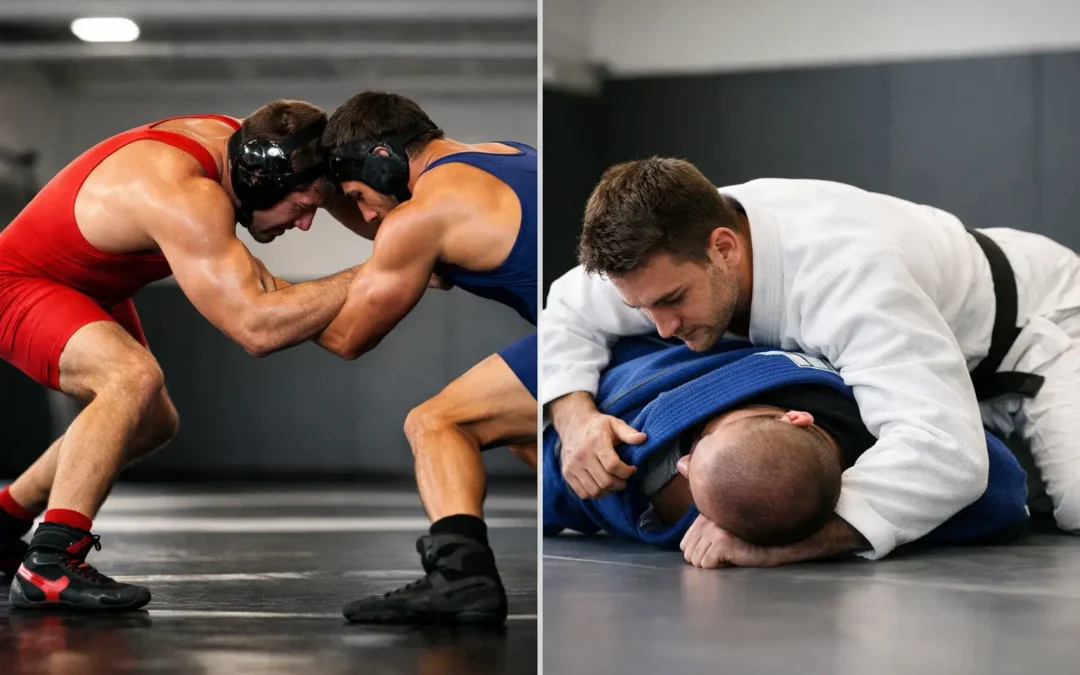
The simplest distinction is where each sport spends most of its time. Wrestling begins standing and places a strong emphasis on takedowns, controlling an opponent from the top, and turning them for points or a pin. It is fast, physical, and demanding from the first exchange.
Brazilian Jiu-Jitsu, often called BJJ, includes standing techniques but typically spends more training time on ground positions. Students learn to control an opponent, defend against submissions, escape from underneath, and apply chokes or joint locks in a supervised setting. Technique and timing matter greatly, especially when one student is smaller than the other.
That contrast affects the pace of training. A wrestling round often feels like a sprint. Athletes fight for hand position, level changes, takedowns, and top control with constant forward pressure. A Jiu-Jitsu round can be intense too, but students may slow the action down, defend carefully, and work through positions with patience.
For a child who needs an energetic outlet and enjoys competition, wrestling can be a strong fit. For an adult looking for a technical challenge with practical self-defense value, Jiu-Jitsu may feel more approachable. Many students benefit from learning both over time.
What Wrestling Develops
Wrestling develops athletic habits that transfer to many sports and everyday movement. Students learn stance, footwork, hand fighting, sprawls, shots, escapes, and the ability to keep working when tired. It strengthens the legs, hips, back, grip, and core while improving coordination and body awareness.
Mentally, wrestling asks students to become comfortable with effort. There is little room to coast through a live round. A student learns to reset after a missed takedown, stay composed after being put on the mat, and keep competing with discipline. That process can be especially valuable for teens who need a healthy challenge and a clear way to measure growth.
Wrestling is also excellent for developing top pressure and takedown defense. A student who can maintain balance, recognize an incoming shot, and control another person’s movement has useful physical awareness. Still, wrestling competition rules do not center on submission holds or prolonged fighting from the guard, so students seeking those skills will need Jiu-Jitsu training as well.
What Brazilian Jiu-Jitsu Develops
Jiu-Jitsu teaches students that strength is useful, but position and leverage can change everything. A smaller student can learn to frame, create space, escape, and regain control rather than trying to overpower someone. This makes BJJ appealing to many adults, including those who have not played sports in years.
Training commonly includes positional drills, partner technique practice, and controlled live rounds known as rolling. Students work from situations such as the mount, side control, back control, and guard. They learn not just how to attack, but how to remain calm when they are underneath a training partner or caught in an uncomfortable position.
That problem-solving element is one of Jiu-Jitsu’s greatest benefits. Every round presents choices: protect your neck, improve your position, defend an arm, create an angle, or use a sweep. Students build patience, awareness, and humility because progress comes from repetition and thoughtful correction, not from forcing every exchange.
For self-defense-minded adults and parents, BJJ offers a valuable framework for controlling distance and handling close contact without immediately relying on strikes. Training must always account for real-world variables, but learning to escape, maintain control, and avoid panic can build meaningful confidence.
Fitness, Safety, and Injury Considerations
Both styles provide serious conditioning, but the feeling is different. Wrestling tends to deliver explosive cardio. The pace, takedown attempts, and scrambles can elevate the heart rate quickly. Students often notice improvements in endurance, power, agility, and mental toughness.
Jiu-Jitsu builds fitness through sustained effort, isometric strength, mobility, grip endurance, and repeated positional work. A hard BJJ class can be exhausting, yet beginners may find it easier to manage because they can learn at a more controlled pace while focusing on technique.
Safety depends less on the name of the style and more on the quality of instruction and gym culture. Good coaching teaches students how to fall, tap, release a hold immediately, control intensity, and respect training partners. Beginners should not feel pressured to prove toughness by rolling or sparring beyond their experience level.
Wrestling can involve impacts from takedowns and intense scrambles. Jiu-Jitsu can place stress on joints and the neck if students ignore taps or use poor mechanics. In either program, certified instructors, age-appropriate classes, clean training spaces, and clear rules make a major difference. Students should communicate injuries early and train consistently rather than trying to make up for missed time with reckless intensity.
Which Is Better for Kids and Teens?
For children, the best program is usually the one that provides structure, positive coaching, and a reason to return next week. A young student who loves fast-paced drills and physical competition may thrive in wrestling. It can teach accountability, listening skills, perseverance, and respect for teammates and opponents.
Jiu-Jitsu may be especially helpful for children who need confidence in close-contact situations or who respond well to technical puzzles. They learn that being smaller does not mean being helpless. They also practice calm communication, controlled movement, and respect for boundaries.
Parents should look beyond whether a child wins early rounds or learns moves quickly. The bigger signs of progress are often quieter: improved focus at home, willingness to try difficult things, better emotional control after setbacks, and more confidence around peers. A strong academy creates those results through consistent mentorship, not intimidation.
Teenagers may benefit from either path depending on their goals. Wrestling can complement school sports and provide a demanding competitive outlet. Jiu-Jitsu can give teens a lifelong skill-based activity that continues well beyond high school. Both can replace idle screen time with disciplined training and a supportive community.
Which Is Better for Adults?
Adults often choose based on their immediate priorities. If your goal is powerful conditioning, takedown skill, and an intense athletic challenge, wrestling is difficult to match. It is direct, demanding, and highly rewarding for people who enjoy pushing their pace.
If you want self-defense awareness, technical depth, and a sustainable martial art you can train for years, Jiu-Jitsu is often the more natural starting point. It gives beginners a structured way to learn at their own level while still providing a serious physical and mental workout.
Your training history matters, too. A former wrestler may feel at home with the pace and pressure of wrestling, then add Jiu-Jitsu to improve ground defense and submission awareness. Someone returning to exercise after a long break may prefer beginning with foundational Jiu-Jitsu classes, where control and technique can be emphasized before intensity rises.
Why Cross-Training Can Be the Strongest Choice
Wrestling and Jiu-Jitsu are not rivals in the sense that one makes the other unnecessary. They solve different parts of the grappling puzzle. Wrestling gives students strong takedowns, balance, pressure, and the ability to dictate where an exchange happens. Jiu-Jitsu adds guard work, submissions, escapes, and a deeper understanding of how to work from difficult ground positions.
A student who combines them can become more complete. Wrestlers often bring excellent pace and top control into BJJ. Jiu-Jitsu students can gain confidence by improving their stance, takedowns, and ability to stay on their feet. The transition takes humility because each art exposes gaps in the other, but that is where real growth happens.
At United Martial Arts Katy, students can build that growth in a structured, family-friendly setting where instruction is matched to age, experience, and personal goals. Beginners do not need to arrive in peak condition or know every rule. They need a willingness to learn, train safely, and show up consistently.
The better question is not whether wrestling or Jiu-Jitsu is tougher. It is which discipline will help you or your child build the confidence, discipline, and habits to keep training. Start with the class that feels like a good challenge, listen to experienced instruction, and give progress enough time to become visible.


Recent Comments