

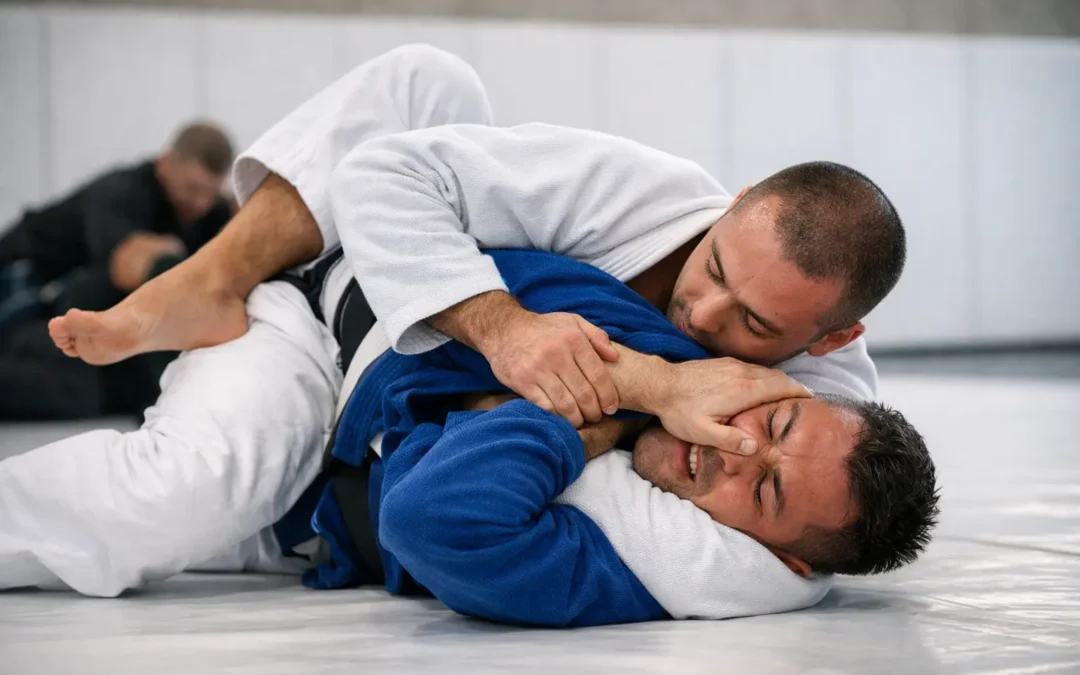
A Brazilian Jiu-Jitsu match can change in seconds. One moment, a student is defending from the bottom; the next, they have controlled an arm, protected their position, and earned a tap. That is the value of BJJ submissions: they teach students how to finish a grappling exchange through leverage, timing, and control instead of relying only on size or strength.
For children, teens, and adults, learning submissions is not about trying to hurt a training partner. It is about developing calm decision-making under pressure, respecting clear boundaries, and building practical skill through disciplined repetition. In a well-run academy, the tap is not a defeat. It is communication, safety, and a sign that both partners are training responsibly.
What Are BJJ Submissions?
A submission is a technique that places an opponent in a controlled position where continuing would risk discomfort, injury, or loss of consciousness. The opponent signals that they are done by tapping – usually with a hand, sometimes with a foot, or verbally when their hands are unavailable.
Most Brazilian Jiu-Jitsu submissions fall into two categories. Joint locks apply controlled pressure to a joint, such as the elbow, shoulder, knee, ankle, or wrist. Chokes restrict the blood flow around the neck when correctly applied, creating a fast and controlled reason to tap. Unlike striking-based self-defense, Jiu-Jitsu gives practitioners options to manage distance, establish control, and end a physical confrontation without throwing punches.
That distinction matters. A submission should never be forced quickly or recklessly. The goal is to apply technique with enough control that a partner has time to recognize the position and tap. Good Jiu-Jitsu looks disciplined, not wild.
Why BJJ Submissions Matter Beyond Competition
Competition is a valuable test of skill, but submissions serve a bigger purpose in everyday training. They teach students to solve a physical problem in sequence: improve position, control the opponent, isolate a limb or create an angle, then apply the finish patiently. If any part of that sequence is missing, the technique is less reliable.
This process develops habits that transfer beyond the mat. Students learn not to panic when they are uncomfortable. They learn that rushing often creates mistakes. They also learn to make decisions with a clear head when another person is resisting their plan.
For adults, this makes BJJ an engaging alternative to a routine workout. Training includes conditioning, mobility, grip strength, balance, and core control, but the mental challenge keeps classes fresh. For teens, submissions can build confidence without encouraging aggression. For younger students, age-appropriate Jiu-Jitsu drills reinforce listening, body awareness, patience, and respect for their classmates.
The Most Common Submission Families
Beginners do not need to memorize dozens of finishes. They need a small number of high-percentage techniques and a clear understanding of when they work. The best early submissions are often the ones that reinforce safe positioning and basic control.
Chokes
Chokes are commonly taught from positions such as the back, mount, guard, and side control. Rear naked chokes, collar chokes, triangle chokes, and arm triangles are familiar examples. Each has different details, but the principle is similar: control posture and create pressure around the neck without relying on a hard squeeze.
A properly coached choke is technical. Students learn hand placement, head position, body alignment, and when to release immediately. Because chokes can become serious if misused, they require close attention, maturity, and respect for training rules.
Arm Locks and Shoulder Locks
Arm bars, kimuras, americana locks, and straight arm locks teach students how to isolate a limb and control the body around it. A successful arm lock does not come from yanking an arm away from a resisting opponent. It comes from controlling the shoulder line, limiting movement, and extending or rotating the joint gradually.
These techniques are excellent lessons in leverage. A smaller student can often create effective control when their hips, legs, and body position are working together. At the same time, they reveal why technique has limits. Poor positioning can make even a familiar arm bar ineffective, while trying to force it can expose the attacker to an escape or reversal.
Lower-Body Attacks
Ankle locks, kneebars, toe holds, and heel hooks are part of modern Jiu-Jitsu, but they are not all introduced at the same stage. Lower-body submissions can create fast pressure and require especially careful instruction. Many beginner programs focus first on positional awareness, escapes, and safer foundational attacks before adding more advanced leg entanglements.
That progression is intentional. Students should earn complexity by showing control, awareness, and responsible training habits. An academy that prioritizes safety does not rush students into techniques simply because they are popular online or successful in elite competition.
Position Before Submission
One of the most valuable lessons in BJJ is simple: position comes before submission. A student who reaches for a finish without controlling the opponent often loses balance, gives up space, or ends up in a worse position.
Consider an arm bar from mount. If the top player has not stabilized the mount, controlled the arm, and managed the opponent’s movement, the arm bar may fail before it begins. The same idea applies to a choke from the back. Hooks, chest-to-back connection, and head control make the submission far more effective and far safer to apply.
This is why beginners spend so much time on guard retention, passing, side control, mount, back control, escapes, and transitions. Those skills are not separate from submissions. They are the foundation that makes submissions possible.
Training BJJ Submissions Safely
Safety is a skill, not an afterthought. Every student has a responsibility to protect their partner, particularly when training with someone smaller, newer, younger, or returning from an injury. The strongest room is not the one where people train hardest every round. It is the one where people can train consistently because they trust one another.
Students should apply submissions slowly in drilling, giving partners time to recognize the pressure. In live sparring, the pace may increase, but control must remain. A tap means release immediately. There is no extra second to prove a point.
Communication matters just as much. Let an instructor know about injuries or limitations before class. Ask a partner if they are comfortable with the round’s intensity. If a position feels unfamiliar, pause and ask questions rather than guessing. This is especially important with neck attacks and leg locks, where small details can make a major difference.
Parents can feel confident when they see this culture in action. Youth instruction should emphasize controlled movements, appropriate techniques for the age group, attentive coaching, and good sportsmanship. Children do not need adult-level intensity to gain confidence and skill. They need structure, encouragement, and safe repetition.
How Beginners Improve Their Submission Game
The fastest way to improve is not to chase a new submission every week. Choose a few techniques that connect to the positions you are learning, then practice the entire sequence. If you are working from closed guard, learn how to control posture, break balance, attack, and respond when the first attempt does not work.
It also helps to treat failed submissions as useful information. Did your opponent pull their arm free because you lost control of the shoulder? Did they escape the choke because there was space near the neck? Did you attack before establishing position? These questions create better progress than simply counting taps.
A reliable training approach includes technical drilling, positional sparring, and live rounds. Drilling builds clean movement. Positional sparring lets students repeat a realistic problem from a specific starting point. Live rounds test timing, composure, and decision-making against resistance. Each part has a purpose, and none should replace the others.
At United Martial Arts Katy, structured Brazilian Jiu-Jitsu instruction gives students a clear path from fundamentals to more advanced application. Beginners do not have to arrive already fit, flexible, or experienced. They need a willingness to learn, a respectful mindset, and consistent attendance.
Submission Skill Builds Responsible Confidence
The best BJJ practitioners are not eager to prove how tough they are. They know that real control includes the ability to slow down, disengage, and make safe choices. Submission training builds confidence because students repeatedly face pressure, learn a response, and see their skills improve over time.
Whether your goal is self-defense, fitness, competition, or a stronger sense of discipline, start with the fundamentals and respect the process. A well-earned tap is only one moment in training. The greater achievement is becoming the kind of student and teammate others can trust on the mat.


Recent Comments